



Most people walk past fire doors dozens of times a day without giving them a second thought. They prop them open with wedges, let them slam shut behind them, or ignore the fact that the closer hasn’t worked properly in months. It’s only when something goes wrong — really wrong — that fire doors suddenly get the attention they deserve. By then, of course, it can be too late.
So who’s actually supposed to be keeping an eye on these things? The answer isn’t always obvious, and that ambiguity has real consequences.
More Than Just a Heavy Door
A fire door isn’t just a thick slab of wood or steel hung on sturdy hinges. It’s an engineered assembly — the leaf, the frame, intumescent seals, smoke seals, a self-closing device, and the right ironmongery all working together. When everything is in order, a fire door holds back flames and toxic smoke for a certified period, buying occupants the time they need to get out alive.
The trouble is that fire doors deteriorate. Hinges work loose. Seals crack and peel. Self-closers lose their spring. Gaps that were once within tolerance slowly widen. None of this happens dramatically — it creeps in over months and years. And unless someone is actively looking for these problems, they go unnoticed until the door is tested by an actual fire.
Coroners’ reports and public inquiries have pointed to defective fire doors time and again as contributing factors in fire deaths. That’s not a statistic anyone wants to be part of.
What the Law Says
In England and Wales, the main piece of legislation is the Regulatory Reform (Fire Safety) Order 2005 — the FSO, as most people in the industry call it. Under the FSO, the “responsible person” has to carry out a fire risk assessment and take sensible steps to deal with whatever risks come up. Fire doors are very much part of that picture.
After the Grenfell Tower tragedy, the Fire Safety Act 2021 tightened things further, particularly for residential buildings with multiple occupants. If a building is over eleven metres tall, flat entrance doors now need inspecting at least once a year, and fire doors in communal areas should be checked every three months. That’s not guidance — it’s a legal requirement.
Scotland and Northern Ireland have their own rules, but the underlying expectation is the same: if you’re in charge of a building, you’re in charge of its fire doors.
So Who Is the “Responsible Person”?
This is where things can get a bit tangled, especially in buildings with complicated ownership or management arrangements.
In a workplace, it’s usually the employer or whoever controls the premises. In a block of flats, it could be the freeholder, the landlord, a management company, or a managing agent. In mixed-use buildings — a shop on the ground floor, offices above, flats on top — there might be several responsible persons, each covering different parts of the building.
When multiple parties share that duty, they’re expected to cooperate and coordinate. In practice, that doesn’t always happen smoothly, which is exactly how fire doors end up falling through the cracks. The bottom line, though, is clear: someone must own the inspection process, keep records, and make sure problems get fixed promptly.
Getting the Right People to Do the Job
It’s one thing to know that inspections need to happen. It’s another to make sure they’re done properly. The law requires the responsible person to either be competent themselves or to appoint someone who is. Competence in this context means understanding the relevant standards — BS 476-22, BS EN 1634-1, and BS 8214 among them — along with the manufacturer’s specific guidance for installation and maintenance.
There are third-party certification schemes run by organisations like the BRE, BWF-Certifire, and FDIS, and these carry real weight. But not every building needs to hire a specialist for every check. Facilities managers, maintenance staff, and safety officers can handle routine inspections effectively if they’ve had the right training. A well-structured fire door inspection course helps these teams understand what to look for and gives them the confidence to spot common defects.
Keeping records of who carried out each inspection and what qualifications they hold isn’t just good practice — it’s the kind of evidence that matters enormously if regulators come knocking or, worse, if there’s a fire investigation.
What Inspectors Actually Look For
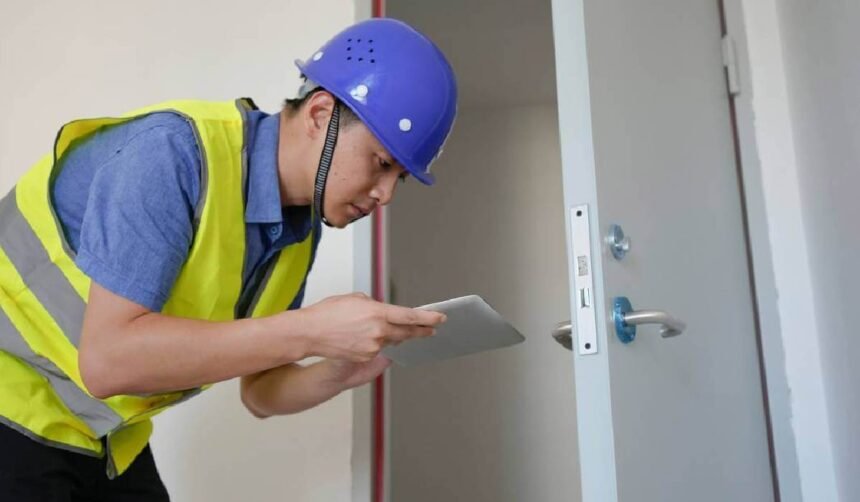
A proper fire door inspection is methodical. The inspector checks the door leaf for damage and looks for the certification label or plug. They measure the gaps between the door and frame — anything beyond the standard three-millimetre tolerance is a problem. Intumescent strips and smoke seals get examined for continuity. The self-closer is tested to make sure it pulls the door fully shut from any angle. Hinges are checked for security, and any glazed panels are verified against their fire-rated specification.
Everything goes into a structured report: the door’s location, its condition, any defects, the severity of those defects, and what needs to happen next. This report feeds into the building’s broader fire risk assessment and creates the paper trail that demonstrates due diligence.
Everyone Has a Part to Play
While the formal duty sits with the responsible person, the people who use a building every day make a bigger difference than they might realise. Wedging a fire door open — even just for five minutes to carry boxes through — can be the difference between a contained incident and a catastrophe, unless the door has an approved hold-open device linked to the fire alarm system.
Tenants and employees should report damage or anything that doesn’t seem right. A door that doesn’t latch properly, a closer that’s been disconnected, a seal that’s hanging loose — these are all things worth flagging. Employers can encourage this kind of awareness by investing in broader fire safety courses for their teams. When people understand why fire doors matter, they stop treating them as an inconvenience and start seeing them for what they are: a line of defence.
The Cost of Getting It Wrong
Fire and rescue authorities don’t take fire door failures lightly. They can issue enforcement notices and prohibition notices, and in serious cases they can prosecute. Fines under the FSO are unlimited, and the most serious breaches can lead to prison. The direction of travel is clear — regulators are becoming less patient, not more.
The Short Version
If you own, manage, or control a building, fire door inspections are your responsibility. They need to happen regularly, they need to be done by people who know what they’re looking at, and the findings need to be acted on. It’s not glamorous work, and it’s easy to let it slide when there are a hundred other things demanding attention. But fire doors exist to save lives, and they can only do that if someone is paying attention.