



Yoga draws people in for many reasons: the breath, the stillness, the sense of connection between mind and body. Over time, a dedicated practice can open the hips, lengthen the spine, and settle a restless mind in ways few other disciplines can match.
But even committed yogis sometimes hit a wall. Flexibility plateaus. Certain poses feel shakier than they did a year ago. A dull ache settles into the lower back or wrists that never quite goes away.
These are not signs that the practice is failing. They are often signals that something else is needed, a layer of support that yoga alone does not always provide.
The Moment Many Yogis Realize Flexibility Is Not Enough
There is a point in almost every yoga journey where the range of motion stops feeling like the whole answer. You can fold deeply, extend freely, and still find yourself shaking in Warrior III or compressing through the lumbar spine every time you move into a backbend.
Flexibility, it turns out, is only one part of functional movement. Without the muscular support to manage that range, the body starts to compensate, and compensation is where fatigue and strain begin.
Why Some Yoga Poses Start Feeling Harder Instead of Easier
- Wrist fatigue during weight-bearing poses like Plank or Downward Dog often signals that the shoulders and core are not absorbing enough load.
- Hip instability in standing balances reflects a lack of deep rotator strength rather than insufficient flexibility.
- Lower back compression in backbends and forward folds often comes from the spine doing work that the hips and core should share.
- Shaky inversions, even after years of practice, point to a gap between mobility and the neuromuscular control needed to sustain a position.
These are not flexibility problems. They are stability problems, and that distinction matters enormously for how they get addressed.
The Difference Between Mobility and Control
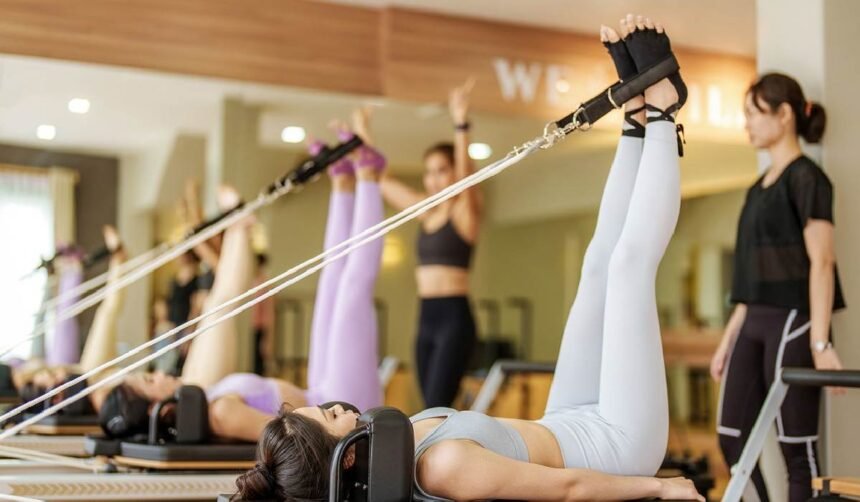
Mobility is the capacity to move through a range. Control is the ability to own that range — to move into it, hold within it, and return from it with intention. Reformer Pilates trains control. The spring-loaded resistance of the reformer challenges the muscles that stabilize joints rather than simply lengthen them, which is exactly what fills the gap that flexibility-dominant training leaves behind.
Why Reformer Pilates Feels So Natural for Yoga Practitioners
For yogis who have never tried the reformer, the first session is often a surprise. It does not feel like crossing into foreign territory. It feels familiar in a way that is hard to name immediately, because the two practices share more foundational principles than most people expect.
The Mind-Body Connection Feels Familiar
Both practices treat breath as a tool, not an afterthought. Reformer sessions are organized around exhale and inhale just as deliberately as a vinyasa flow. Precision matters in both disciplines. Reformer work asks practitioners to be as attentive to hand placement, spinal length, and pelvic position as any yoga teacher would.
The pace of reformer training is controlled and deliberate. There is nothing jarring or aggressive about it. Movements are slow, intentional, and deeply felt, which is exactly the quality that draws most people to yoga in the first place. Many yogis find that their body awareness, built through years of attending to alignment and sensation, gives them a genuine advantage on the reformer from the very first session.
Resistance Training Without Losing Fluidity
The reformer’s spring system offers graded resistance that supports the body through movement rather than forcing it to fight against external load. This means joints are often more protected during reformer work than during free-weight training.
The carriage glides, the straps guide, and the springs meet the body where it is, creating a training environment that builds genuine strength while keeping movement smooth, connected, and joint-friendly.
What Changes After Adding One Weekly Reformer Session
The results that yogis describe after introducing a single weekly reformer session tend to cluster around a few consistent themes. None of them are dramatic overnight shifts. They are the kind of quiet, compounding improvements that become obvious in retrospect.
Stronger Balance in Standing and Inversion Poses
Deep core engagement, particularly through the transverse abdominis and pelvic floor, becomes more accessible and more automatic. Standing balances that felt effortful begin to feel steadier, not because flexibility improved but because the supporting muscles are now actually doing their job. Inversions become more controlled at the entry and exit rather than just at the peak of the pose.
More Support in the Spine and Hips
The muscles around the pelvis, particularly the deep hip rotators and glutes, grow stronger through reformer footwork and leg spring exercises, directly reducing lower back strain during yoga flows.
Postural awareness carries over into everyday life. The sensation of a long, supported spine becomes a reference point the body returns to automatically. Backbends feel more spacious because the core is now available to protect the lumbar rather than leaving it to manage load alone.
Better Recovery Between Yoga Classes
Practices like Pilates Mat Classes already help yogis improve body awareness and movement control, and reformer work builds on that foundation while also supporting active recovery.
The controlled, low-impact nature of reformer training promotes circulation, reduces residual muscular tension, and encourages the body to move through its full range with support rather than fatigue. Many yogis find they arrive at their next class feeling more available rather than more depleted.
Why More Yogis Are Turning to Online Reformer Guidance
For a long time, getting on a reformer meant praying the one class that fit your schedule wasn’t already waitlisted. If the timing didn’t work out, your routine evaporated. Thankfully, things are a bit more flexible now.
Because a reformer is a major investment and definitely doesn’t fit in your suitcase, the smartest move is to find a great Pilates studio right near your home. Instead of racing to catch a packed group class, you can just book some open studio time that actually fits your day.
By firing up a digital program like Pilates Compass right on your phone while you’re at the studio, you get professional, instructor-led sequencing right at your machine. It gives you the best of both worlds: the total freedom to practice on your own schedule, and a solid plan so you aren’t just staring at the springs wondering what to do next.
Practicing With Structure and Consistency at Home
One of the most common reasons yogis stall in any complementary practice is the absence of a clear framework. Without structure, independent studio sessions quickly turn into an improvised mix of the same three exercises, and eventually, the habit just stops happening altogether.
Since a reformer is a large piece of equipment that requires a dedicated space, the most sustainable path is to commit to a routine at a Pilates studio near your home.
It brings the exact sequencing logic, precise cueing, and progressive structure of an experienced instructor straight to your phone while you’re at the machine. This transforms an open-studio slot into a coherent, purposeful workout, so your reformer time stays highly effective instead of drifting into repetition or guesswork.
Creating a Sustainable Weekly Practice
One session per week is genuinely enough to notice meaningful change when that session is well-structured and intentionally sequenced. The goal is not to add volume. It is to add a different quality of stimulus. The kind that asks the body to be stable, controlled, and strong in positions that yoga reaches but does not always reinforce.
Over months, a single weekly reformer session reshapes how a yogi experiences their practice: poses feel more supported, transitions feel more deliberate, and the body simply manages itself better.
Conclusion
Adding a weekly reformer session does not ask yogis to give anything up. The practice they love stays intact. What changes is what surrounds it: more stability, more support, more ease in the poses that used to feel precarious.
The reformer fills in the gaps that flexibility alone leaves open, quietly, consistently, and in a way that accumulates meaningfully over time. For yogis who want to move well in the long term, who want their practice to deepen rather than plateau, one intentional reformer session each week may be the most useful addition to their routine.