



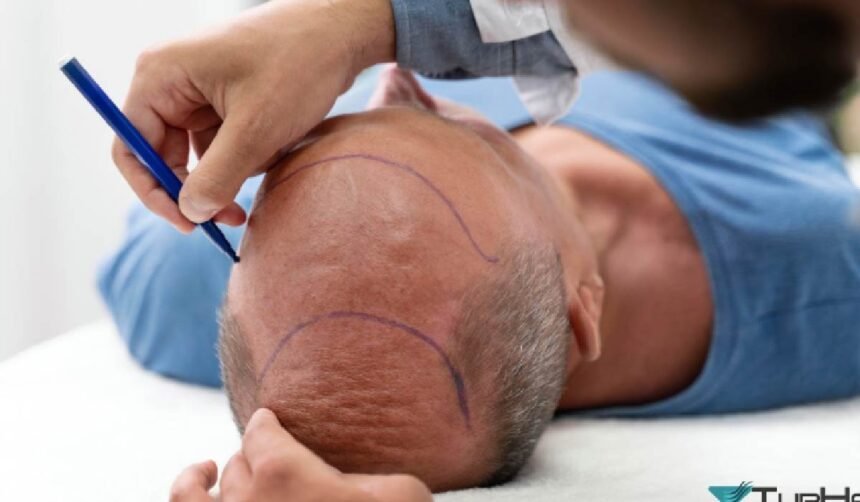
A disappointing hair transplant is usually correctable. Repair surgery, also called revision surgery, rebuilds a result that another clinic left patchy or too thin. At TURHAIR in Istanbul, Dr. Mehmet Sıraç Demir reassesses the scalp, checking remaining donor supply, graft angles and lost density.
Revision is harder than a first operation. The surgeon inherits another clinic’s hairline design, its channel angles and a donor area that may already be overharvested. Planning therefore starts with an honest measurement of what capacity is left.
Why Do Hair Transplants Fail?
Most disappointing results trace back to how the operation was staffed and planned, not to bad luck. High volume clinics compress the surgical stages, and the errors surface years later.
- Critical stages delegated to technicians while the doctor is out of the room
- A hairline copied from a template instead of your own facial proportions
- Wrong graft angles and depth, which create a pluggy, doll like look
- Donor overharvesting or long extraction times that lower graft survival
Channel opening decides direction, angle and density for every follicle. Roughly 70 to 80 percent of the visible outcome is settled at that stage. Rushed or delegated, it produces hair that grows but never sits naturally.
Who is a Candidate for Revision Surgery?
You qualify if at least 12 months have passed and enough donor hair remains for a meaningful correction. Four complaints point most clearly toward repair.
- A hard, straight or overly low hairline that does not suit your face
- Thin coverage in zones that were transplanted but never filled in
- Grafts angled wrongly, so the hair points forward or sideways
- Visible scarring at the recipient site or across the donor area
Dr. Demir assesses each complaint during consultation. Some patients need one session, others a staged approach across two procedures, spaced at least 12 months apart.
Repair Techniques Used at TURHAIR in Istanbul
Patients researching hair transplant repair turkey will find that one operation usually combines several methods. The scalp is mapped first, then techniques are chosen to match it.
- Follicular Unit Extraction (FUE), Sapphire FUE or Direct Hair Implantation (DHI) to redistribute grafts and correct direction
- Hairline reconstruction, softening a hard front line
- Scar camouflage in and around visible scarring
- Graft removal, so misplaced grafts can be reimplanted correctly
- Body hair transplantation when the scalp donor area is depleted
Dr. Demir performs the hairline design, the channel opening and the donor planning himself. TURHAIR treats only 1 to 2 patients per day, which gives a complex repair the time it needs.
Why Must You Wait 12 Months Before a Repair?
Because the previous transplant is still growing, and early surgery risks destroying grafts that would have survived. Most patients notice the first new growth somewhere around month 3 to 4. Significant improvement follows at months 6 to 9, and the final result settles between months 12 and 18.
Waiting also lets the skin recover and scar tissue soften. Dr. Demir asks patients to wait at least 12 months before any revision is planned.
How Many Grafts Does a Repair Need?
Graft requirements depend on the repair type, with published ranges from 500 to more than 4,000. The table below shows the typical range for each category of repair work.
| Repair Type | Typical Graft Range | Main Objective |
|---|---|---|
| Minor density correction | 500 to 1,500 grafts | Filling thin areas between surviving grafts |
| Hairline repair | 1,000 to 2,000 grafts | Rebuilding a natural front line |
| Scar camouflage | 500 to 1,500 grafts | Softening visible donor or recipient scars |
| Major revision | 2,000 to 4,000+ grafts | Rebuilding a large failed zone |
These are typical ranges, not fixed quotas. A repair works inside whatever donor capacity remains, so the plan is built backwards from that limit.
The Recovery Curve After Revision Surgery
Recovery follows the same curve as a first procedure. The stages below apply to the newly placed grafts.
- Days 1 to 7: mild redness and scabbing across the treated area
- Month 3 to 4: first visible growth from the new grafts
- Months 6 to 9: significant improvement in coverage and blending
- Months 12 to 18: the final result, judged against the original scalp
Revision surgery also runs across a single working day, with a typical stay of 2 to 3 nights in Istanbul. Packages cover the procedure, aftercare, hotel, VIP airport transfers and translator support.
The Honest Limits of a Repair
A repair improves what can be improved within the donor supply that remains. The scalp donor area cannot be regrown, so conservative donor management protects what is left. Beard or chest hair can add grafts for the mid scalp and crown.
Where overharvesting was severe, the realistic goal is a natural, softer appearance rather than full density. Results vary by patient, and PRP therapy is sometimes used alongside surgery to support existing hair. Dr. Demir, a member of the International Society of Hair Restoration Surgery (ISHRS), reviews each case individually.
Frequently Asked Questions
Can a Failed Hair Transplant from Another Clinic be Fixed?
In most cases yes, though the extent depends on how much donor hair remains. Revision surgery redistributes grafts, rebuilds the hairline and camouflages scarring. Where the donor area was overharvested, the correction is partial. Dr. Demir examines the scalp and the previous work before proposing any repair plan.
How Soon After a Bad Transplant Can Revision Surgery be Done?
At least 12 months must pass after the previous procedure. Transplanted hair shows first visible growth at month 3 to 4 and keeps improving until months 12 to 18. Operating earlier risks destroying grafts that were still developing. The wait also allows scar tissue to soften and blood supply to recover.
Does Repair Surgery Use More Grafts than a First Procedure?
Not necessarily. Published repair ranges run from 500 to 1,500 grafts for minor density work, up to 2,000 to 4,000 or more for major revision. A first procedure for moderate loss typically uses 2,500 to 3,500 grafts. The difference is complexity, because the surgeon works around existing grafts.
Can Beard Hair be Used If the Scalp Donor Area is Exhausted?
Yes, beard and chest hair can supply extra grafts when the scalp donor zone is depleted. Body hair differs in texture and growth cycle, so it is normally placed in the mid scalp or crown rather than at the hairline. Suitability depends on your hair characteristics and is assessed during consultation.