



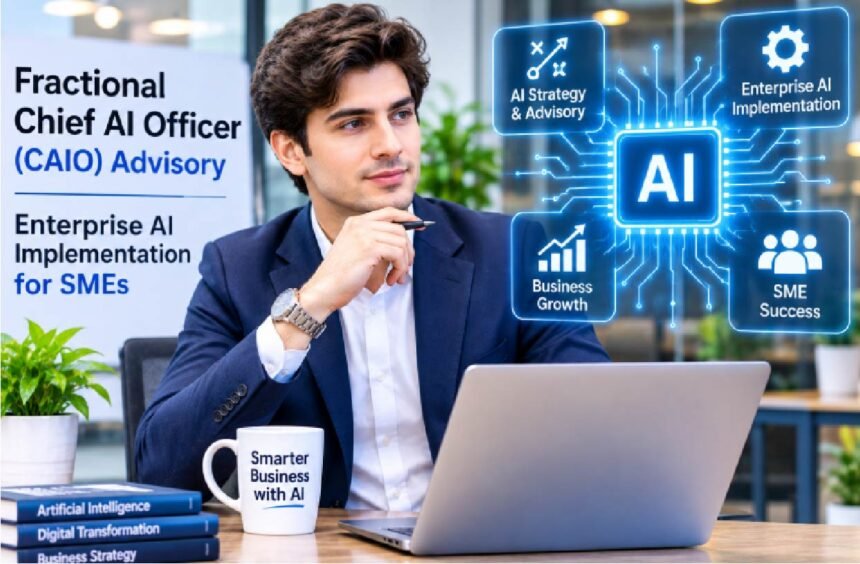
Artificial intelligence is transforming the way businesses operate compete and deliver value to customers.
Small and medium-sized enterprises SMEs are increasingly recognizing the importance of AI in improving efficiency, reducing operational costs, and making better business decisions.
However adopting AI successfully requires more than simply purchasing new software or experimenting with automation tools. Businesses need a clear strategy, reliable data infrastructure, and professional guidance to achieve meaningful results.
This is where fractional Chief AI Officer CAIO advisory services and enterprise AI implementation become valuable.
These solutions allow SMEs to access experienced AI leadership and technical expertise without the financial commitment of hiring a full-time executive team.
Understanding the Role of a Fractional Chief AI Officer
A Fractional Chief AI Officer is an experienced professional who helps businesses identify, plan, and implement artificial intelligence initiatives.
Unlike a traditional full-time executive a fractional CAIO works with an organization on a part-time or project-based basis.
Their primary responsibility is to ensure that AI investments support the company’s broader business objectives.
This includes identifying suitable AI opportunities evaluating technology platforms, establishing implementation priorities, and developing long-term AI strategies.
For SMEs this approach offers several advantages.
Businesses can benefit from executive-level expertise while maintaining greater control over operational expenses.
A fractional CAIO can also help leadership teams avoid unnecessary technology investments and focus on solutions that deliver measurable business value.
Why SMEs Need a Strategic AI Roadmap
Many small and medium-sized businesses understand that AI is important but struggle to determine where to begin.
Without a structured roadmap, organizations may invest in tools that do not address their actual business challenges.
An effective AI roadmap begins with an assessment of existing business operations, available data, technology infrastructure, and organizational goals.
The process typically includes:
- Identifying repetitive tasks that can benefit from automation.
- Evaluating existing data quality and management systems.
- Selecting AI applications that align with business priorities.
- Establishing implementation budgets and realistic timelines.
- Defining performance indicators to measure results.
- Developing employee training and AI adoption strategies.
Professional AI strategy and data science advisory can help organizations understand these requirements and make informed decisions about their AI transformation journey.
Enterprise AI Implementation: Turning Strategy into Results
Developing an AI strategy is only the beginning.
Businesses must also ensure that their selected solutions are properly integrated into existing systems and daily operations.
Enterprise AI implementation involves designing developing testing and deploying AI-powered solutions that address specific business requirements.
For example, an SME operating in the retail industry might use AI to forecast customer demand, optimize inventory management, and personalize marketing campaigns.
A professional services company could implement AI-powered document processing, automated customer support and intelligent workflow management.
Successful implementation generally involves several important stages:
1. Business and Technology Assessment
Before introducing AI, organizations should evaluate their current processes software platforms data availability and operational challenges.
This assessment helps identify the most valuable implementation opportunities.
2. AI Solution Selection
Different business challenges require different technologies.
Machine learning natural language processing, predictive analytics, and generative AI each offer unique capabilities.
Selecting the right solution ensures that businesses avoid unnecessary complexity and focus on practical outcomes.
3. Data Preparation and Integration
AI systems depend on reliable information. Businesses must organize their data address quality issues establish appropriate access controls and connect relevant information sources.
Proper integration also ensures that AI applications work effectively with existing CRM ERP, and other business management platforms.
4. Testing and Deployment
Before introducing AI across an organization, solutions should be tested through controlled projects or pilot programs. This allows businesses to identify technical issues, evaluate performance, and make improvements before wider deployment.
5. Monitoring and Continuous Improvement
AI implementation is not a one-time activity. Systems require ongoing monitoring, performance evaluation, security reviews, and updates to remain effective as business requirements change.
The Benefits of Enterprise AI Consulting for Small Businesses
Professional AI consulting can make complex technology projects more manageable for SMEs.
Instead of attempting to develop every capability internally businesses can work with experienced specialists who understand both technical requirements and commercial objectives.
Working with specialists in enterprise AI consulting and implementation can help organizations evaluate their technology needs, develop practical solutions and integrate AI into existing business environments.
Some of the most important benefits include:
Improved Operational Efficiency: AI can automate repetitive administrative activities, allowing employees to concentrate on more valuable responsibilities.
Better Decision-Making: Predictive analytics and intelligent reporting can help business leaders identify patterns, understand market conditions, and make informed decisions.
Enhanced Customer Experiences: AI-powered chatbots, recommendation systems, and customer data analysis can support faster and more personalized customer interactions.
Reduced Operational Costs: Automation and optimized workflows can minimize manual workloads and improve resource utilization.
Greater Business Competitiveness: SMEs can use advanced AI technologies to improve their services, respond to market changes, and compete more effectively with larger organizations.
AI Governance, Security, and Responsible Adoption
While AI offers significant opportunities, businesses must also consider its potential risks. Data privacy, cybersecurity, regulatory requirements, and inaccurate AI-generated outputs can create serious challenges if they are not managed properly.
A fractional CAIO can help establish appropriate governance policies, define responsibilities, and introduce processes for evaluating AI systems.
Organizations should pay particular attention to sensitive business information, employee access permissions, data protection procedures, and human oversight. AI-generated recommendations should also be reviewed when they influence important financial, operational, or customer-related decisions.
Responsible AI adoption builds trust and helps ensure that technology supports sustainable business growth.
How SMEs Can Begin Their AI Transformation
Businesses do not need to implement multiple AI systems simultaneously. A gradual approach is often more effective, particularly for organizations with limited technical resources.
The first step is to identify one or two operational challenges where AI could deliver measurable improvements. Next, leadership should assess available data, establish clear objectives, and determine the resources required for implementation.
Starting with a manageable pilot project allows an organization to evaluate results before expanding its AI capabilities across additional departments.
With the right combination of strategic leadership, technical expertise, and ongoing evaluation, even smaller businesses can build an effective AI-driven operating environment.
Conclusion
Fractional Chief AI Officer advisory and enterprise AI implementation provide SMEs with a practical pathway toward digital transformation. By combining experienced AI leadership with carefully selected technologies, businesses can improve operational efficiency, strengthen decision-making, and create better customer experiences.
The most successful AI initiatives begin with a clear understanding of business objectives rather than technology alone. Organizations that invest in strategic planning, reliable data management, responsible governance, and professional implementation will be better positioned to achieve sustainable results in an increasingly AI-driven business environment.