
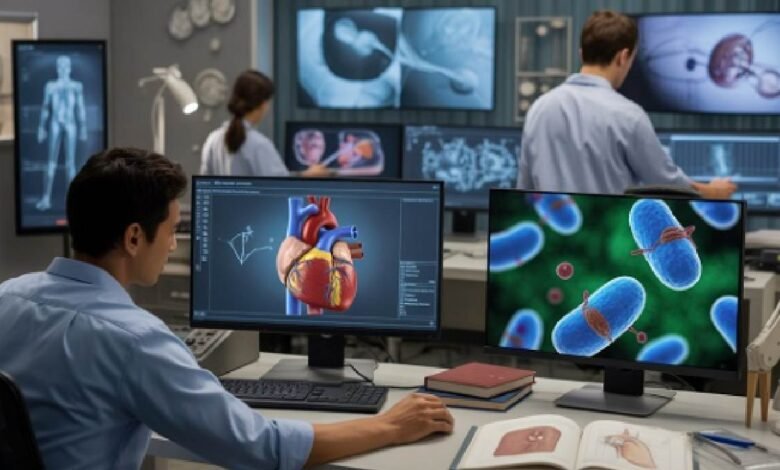
Healthcare information is often complex and highly technical. Doctors, medical students, and patients frequently need to understand biological systems, medical procedures, and treatment methods that are difficult to visualize through text alone.
This is where three-dimensional medical animation has become an important educational tool.
3D medical animation allows healthcare professionals to present detailed visual explanations of the human body, diseases, and treatments. Instead of relying on static diagrams or long descriptions, animation shows biological processes in motion.
These visual demonstrations make complicated concepts easier to understand and remember.
Because of this clarity, animation is now widely used in medical education, patient communication, and pharmaceutical presentations.
Why Visual Learning Matters in Healthcare
The human body is an intricate system made up of organs, tissues, and microscopic biological processes. Explaining how these systems work can be challenging, especially when the information involves cellular or molecular interactions.
Visual learning helps simplify these explanations.
When viewers see processes such as blood circulation, nerve signaling, or disease progression through animation, they can understand how different parts of the body interact. Motion, color, and perspective help clarify information that would otherwise be difficult to imagine.
Healthcare organizations often use 3D medical animation services to create educational content that illustrates these processes clearly.
This visual approach improves comprehension for both professionals and patients.
Supporting Medical Education and Training
Medical schools and healthcare institutions rely heavily on visual resources to train students and professionals.
Students studying anatomy or surgical techniques must understand how the body functions at both structural and microscopic levels. Traditional textbooks and diagrams are helpful, but animation provides a more dynamic way to observe these systems.
Through animated sequences, learners can watch how organs interact, how diseases affect tissues, and how procedures are performed.
This ability to observe processes repeatedly improves knowledge retention and supports deeper understanding.
Universities and hospitals often collaborate with specialists from a 3D animation studio to create educational animations used in lectures, training modules, and medical simulations.
Improving Patient Communication
Patients frequently receive complex medical explanations when discussing diagnoses or treatment options. Medical terminology can be difficult to understand, especially for individuals without a healthcare background.
Animation helps bridge this communication gap.
For example, a patient preparing for surgery may watch an animated video that shows how the procedure will be performed. Seeing the process visually can help reduce anxiety and provide a clearer understanding of the treatment.
Hospitals and healthcare providers often rely on 3D medical animation services to produce patient education materials that explain medical procedures in a clear and accessible way.
This visual approach allows patients to make more informed decisions about their healthcare.
Demonstrating Pharmaceutical Mechanisms
Pharmaceutical companies frequently use animation when presenting how medications interact with the body.
Many drugs work by targeting specific biological pathways or cellular receptors. These mechanisms are difficult to explain using simple graphics or text descriptions.
Three-dimensional animation can illustrate how a medication travels through the bloodstream, interacts with cells, and produces its therapeutic effect.
These detailed visualizations are particularly useful during presentations to healthcare professionals, regulatory agencies, and investors.
Pharmaceutical organizations often collaborate with a 3D animation studio to produce accurate scientific visualizations that communicate complex data effectively.
Showing Biological Processes in Detail
One of the most valuable aspects of three-dimensional medical animation is its ability to reveal details that cannot easily be observed in real life.
For example, animation can show microscopic interactions such as:
- Virus particles entering cells
- Immune responses fighting infections
- Drug molecules binding to receptors
- Cellular regeneration during healing
These processes occur at a scale that cannot easily be captured with traditional video footage.
Through animation, viewers can observe these events in a way that makes the science easier to understand.
Healthcare researchers and educators often use 3D medical animation services to illustrate these microscopic processes with scientific accuracy.
Expanding Healthcare Education Online
Digital platforms have become a major source of health information for both professionals and the general public.
Medical institutions frequently publish educational videos online to explain diseases, treatment options, and preventative health measures.
Three-dimensional animation works especially well in this environment because it transforms complex information into engaging visual content.
Online viewers can pause, replay, and review animated explanations at their own pace, making it easier to absorb important details.
Many healthcare organizations collaborate with a 3D animation studio to produce animated content for websites, medical learning platforms, and educational campaigns.
Why 3D Medical Animation Continues to Grow
As medical science advances, the need for clear communication becomes even more important. New treatments, technologies, and research discoveries require effective ways to explain complex ideas.
Three-dimensional animation offers a powerful solution.
By combining scientific accuracy with visual storytelling, animation helps healthcare professionals communicate knowledge more effectively. It allows audiences to see processes that are otherwise invisible.
This ability to transform complicated medical information into understandable visuals makes animation an increasingly valuable tool in healthcare.
Frequently Asked Questions
What is 3D medical animation?
3D medical animation uses three-dimensional visuals to explain biological processes, medical procedures, and treatments in a clear and engaging way.
Who uses medical animation?
Medical schools, hospitals, pharmaceutical companies, and healthcare organizations commonly use medical animation for education and communication.
Why is 3D animation useful in healthcare?
Three-dimensional animation helps visualize complex medical concepts that are difficult to explain through text or static images.
Can medical animation help patients understand treatments?
Yes. Animated visuals can show how procedures work and how treatments affect the body, helping patients understand their healthcare options.
Where is medical animation commonly used?
Medical animation is used in medical training, patient education, pharmaceutical presentations, research communication, and healthcare marketing.
Final Words
Three-dimensional medical animation has become an essential resource for healthcare education and communication. By visually demonstrating biological processes, medical procedures, and pharmaceutical mechanisms, animation helps doctors, students, and patients understand complex medical topics more clearly.
As healthcare information continues to evolve, 3D animation will remain a powerful tool for improving how medical knowledge is shared and understood.