
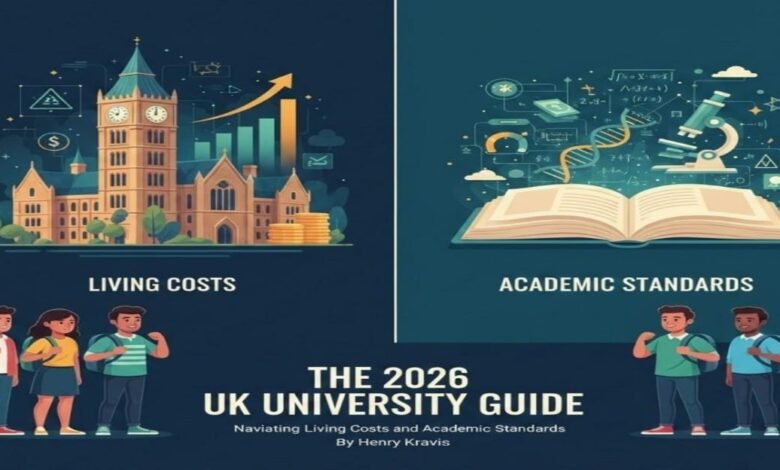
By Henry Kravis
For decades, the United Kingdom has stood as a beacon of academic prestige. However, as we move into the 2026 academic year, the landscape for international students has shifted. It isn’t just about getting an offer letter anymore; it’s about strategic financial planning and meeting elevated academic benchmarks.
Whether you are a high school student in Mumbai, Lagos, or Dubai eyeing a 2026 UK university intake, this guide breaks down the “new normal”—from rising maintenance requirements to the rigorous standards of British degrees.
1. The Financial Blueprint: Living Costs in 2026
The most significant change for 2026 is the UK Home Office’s updated financial requirements. To secure a UK Student Visa, applicants must prove they have specific “maintenance funds” held for at least 28 days.
Updated 2026 Monthly Expense Requirements
To reflect global inflation, the Home Office has adjusted the required monthly savings. These figures are the mandatory minimum for your visa application:
| Location | Required Monthly Funds (Up to 9 Months) | Total Evidence Needed |
| Inside London | £1,529 | £13,761 |
| Outside London | £1,171 | £10,539 |
Realistic budgeting for a student lifestyle in cities like Manchester, Birmingham, or Glasgow suggests a monthly spend of £1,200–£1,400 to cover private rentals and utilities. In London, this figure can easily climb to £1,900+ if you opt for private student halls in Zone 1.
2. Rising Academic Standards: Quality Over Quantity
The UK’s “International Education Strategy” now emphasizes higher entry bars. For students, this means the requirements for success are more stringent than ever.
- Tightened English Proficiency: While an IELTS 6.0 was once common, top-tier institutions in 2026 increasingly demand a 7.0 or 7.5, particularly for Law, Medicine, and Humanities.
- AI and Academic Integrity: With universities deploying advanced AI-detection protocols (like Turnitin’s 2026 suite), the focus on original, research-driven work is absolute.
- STEM-Specific Rigor: For those in tech-heavy fields, the jump from high school to UK degree level is steep. Many students now seek specialized computer Science assignment help to master complex modules like Neural Networks or Advanced Cryptography, which are now standard in first-year curricula.
- Employability Modules: Most 2026 degree paths now include compulsory “real-world” simulations. You will be assessed on practical application, not just theory.
3. Strategies for Success: Balancing the Books
How do you thrive in a high-cost, high-standard environment? It requires a mix of “student hacks” and professional academic preparation.
- Regional Selection: Look beyond the “Golden Triangle.” Cities like Sheffield, Cardiff, and Belfast offer world-class Russell Group education with significantly lower rent.
- The 20-Hour Rule: International students can still work 20 hours per week during term time. With the 2026 National Living Wage increases, part-time work is a viable way to cover “lifestyle” costs.
- Expert Academic Guidance: The transition to the rigorous British essay-writing style is often the biggest hurdle. Many students now seek specialized academic help to master complex marking rubrics and ensure their dissertations meet the high linguistic standards required for a First-Class degree.
4. The 2026 Visa Landscape: What’s New?
The UK government’s “Plan for Change” has introduced more frequent Credibility Interviews. When applying for your visa in 2026, expect to be asked detailed questions about your specific modules and how they align with your long-term career goals.
Furthermore, while the Graduate Route (Post-Study Work) remains a draw, the window to transition to a sponsored “Skilled Worker” visa has become the primary metric for success for the Home Office.
Frequently Asked Questions
Q.1 How much money do I need in my bank account for a 2026 UK Student Visa?
You must show tuition fees plus £1,529/month (London) or £1,171/month (Outside London) for nine months. This must be held for 28 consecutive days.
Q.2 Is the Graduate Route (Post-Study Work) still available in 2026?
Yes, graduates can stay for two years (three for PhDs), provided they complete their degree at a compliant Higher Education Provider.
Q.3 How can I ensure my assignments meet UK academic integrity standards?
Focus on original analysis and strict adherence to referencing styles like Harvard or OSCOLA. Utilizing peer-review resources or professional guidance can help bridge the gap for students unfamiliar with the UK’s strict marking criteria.
Conclusion: Is the UK Still Worth It?
Absolutely. Despite the rising costs, the ROI of a UK degree remains high. A 2026 graduate enters the global job market with a credential that signifies prestige, critical thinking, and adaptability. The secret lies in early preparation—start your scholarship searches 12 months in advance and utilize every academic resource available.
About the Author: Henry Kravis
Henry Kravis is a senior education consultant and academic Integrity specialist with over 8 years of experience helping international students navigate the UK higher education system. Having worked with students from Southeast Asia and the Middle East, Henry specializes in transitional academic support and visa compliance. He is a frequent contributor to education journals on the impact of AI on academic honesty.