



You hit a pothole on a country road and your car bounces three times before settling. Or maybe it pulls gently to the left every time you ease off the wheel. Something feels off, but you are not sure if it is serious enough to book in. Sound familiar?
Your suspension works silently in the background, absorbing every bump, dip, and imperfection in the road. When it starts to go, the signs are usually there. You just need to know what to look for. Catching a suspension problem early can save you from a hefty repair bill and, more importantly, keep you safe on the road.
Whether you are driving through Farnborough, commuting from Fleet, or doing the school run in Ash Vale, this guide will walk you through exactly what to watch, feel, and listen for.
What Does Your Suspension Actually Do?
Think of your suspension as the buffer between your car and the road. It keeps your tyres in firm contact with the surface, stabilises the body of the vehicle through corners and braking, and absorbs the energy from bumps so it does not travel straight into the cabin.
It is made up of several components working together, each with a specific role. If you want a deeper understanding of how it all fits together, this complete guide to car suspension systems is a great place to start.
| Component | Role |
| Shock absorbers | Dampen the bouncing motion of the springs and control wheel movement |
| Coil springs | Absorb the initial impact from bumps and support the weight of the vehicle |
| Ball joints | Connect the steering knuckle to the control arms, allowing smooth movement |
| Control arms | Link the wheel hub to the vehicle chassis and guide wheel movement |
| Bushings | Cushion the joints between components and reduce vibration and noise |
| Struts | Combine the spring and damper into one unit, also supporting the vehicle structure |
When even one of these components wears out, the whole system is affected. A problem with your bushings, for example, can put extra strain on your ball joints. A worn shock absorber can accelerate tyre wear. Everything is connected, which is why a full inspection rather than a single component check always gives you a clearer picture.
7 Warning Signs Your Suspension May Be Failing
These are the symptoms most drivers notice first. Some are obvious, others are easy to brush off as “just the road.” Do not ignore them.
1. Excessive Bouncing After Bumps
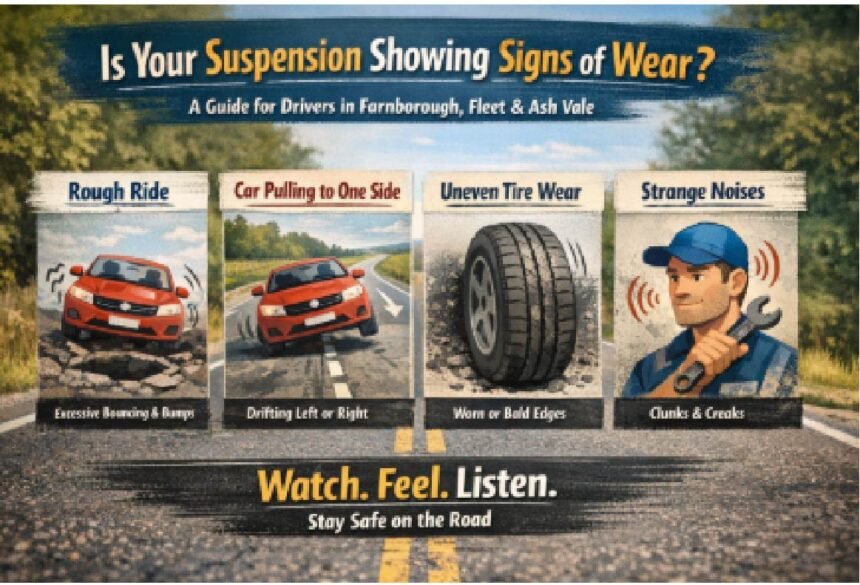
If your car continues to bounce after hitting a bump rather than settling quickly, your shock absorbers are likely worn. A healthy suspension dampens movement almost immediately. A simple way to test this at home is the bounce test, which we cover further down.
2. Your Car Pulls to One Side
A car that drifts left or right without input from the steering wheel is telling you something is wrong. This can point to worn suspension components, a wheel alignment issue, or uneven tyre pressure. Drivers around Aldershot and Tongham who regularly use roads with poor surfaces or sharp cambers tend to notice this symptom sooner than most.
Key causes to be aware of:
- Worn or damaged shock absorbers
- Misaligned wheels caused by a suspension fault
- Deteriorated control arm bushings
- Uneven tyre wear linked to suspension movement
3. Clunking or Knocking Noises
Strange noises from underneath your car when going over bumps are one of the clearest signs of a suspension problem. A clunking or knocking sound usually points to worn ball joints, loose control arms, or degraded bushings that no longer cushion movement properly.
Do not confuse this with a rattle from a loose exhaust or trim panel. If the noise changes depending on road surface or speed, the suspension is the most likely cause.
4. A Rough or Uncomfortable Ride
Your car should filter out most of the road’s imperfections. If every small bump feels sharper than it used to, or the ride has gradually become harsher over time, worn shock absorbers or damaged springs are usually to blame.
This one creeps up on drivers slowly. Because it worsens over months rather than overnight, it is easy to assume it is just the road. If journeys around North Camp or Farnham suddenly feel bumpier than they used to, trust that instinct and get it checked.
5. Uneven Tyre Wear
Your tyres should wear evenly across the full width of the tread. If one edge is wearing faster than the other, or if you notice cupping (scalloped dips around the tyre), the suspension is likely failing to keep the tyre flat against the road.
Uneven wear is also a sign that your wheel alignment may be out, which is often caused by a worn suspension component in the first place. Left unchecked, it will shorten the life of your tyres significantly.
6. One Corner Sits Lower Than the Rest
Park your car on a flat, level surface and step back to look at it. All four corners should sit at roughly the same height. If one corner appears to sag, a coil spring in that corner may have weakened or broken.
You might also hear a clunking sound from that corner when driving over uneven ground. This is a straightforward visual check that takes less than a minute and can flag a serious fault before it worsens.
7. Nose-Diving Under Braking or Rolling on Corners
When you brake, your car should slow in a controlled, balanced way. If the front dips sharply downward, your shock absorbers are not controlling the weight transfer properly. Similarly, if the car leans excessively to one side when cornering, the suspension is no longer keeping the body stable.
Both of these symptoms affect your stopping distance and handling, making them genuine safety concerns rather than just comfort issues.
The Bounce Test: Check Your Suspension in 60 Seconds
This is a quick, no-tools-needed check any driver can do on their driveway.
- Park on flat, level ground and apply the handbrake.
- Press down firmly on one corner of the car, then release.
- Count how many times the car bounces before it settles.
- Repeat on all four corners.
If any corner bounces more than twice, the shock absorber at that corner is likely worn and should be inspected by a professional. One or two clean bounces is normal. Continued movement is not.
Could a Suspension Fault Fail Your MOT?
Yes, it can. Suspension components are checked as part of the standard MOT inspection. Worn shock absorbers, damaged ball joints, deteriorated bushings, and broken springs can all result in a failure if they fall below the required standard.
According to GOV.UK MOT guidance, the test covers steering and suspension components as part of its roadworthiness assessment. If your car is due for a test and you have noticed any of the symptoms above, it is worth having the suspension checked beforehand. A pre-MOT inspection through a trusted car servicing provider can identify issues before they result in a failure.
Modern garages are also increasingly using diagnostic tools to assess suspension health more accurately. You can read more about how technology is changing car servicing in 2026 and what that means for drivers.
What Happens If You Ignore Suspension Problems?
It is tempting to put off a repair when the car still drives, just not quite as well as it used to. But suspension faults do not stay the same. They get worse, and they take other parts down with them.
Here is what can happen when warning signs are left unaddressed:
Tyre damage accelerates. A suspension fault that pulls your wheel out of alignment will chew through a tyre in a fraction of the normal time. You end up replacing tyres far more frequently than you should.
Braking distance increases. Worn shock absorbers reduce the amount of tyre in contact with the road during braking. In an emergency stop, that difference matters enormously.
Other components wear prematurely. Suspension parts work as a system. When one component is failing, it puts extra stress on everything around it. Ball joints, control arms, wheel bearings, and even steering components can deteriorate faster as a result.
You risk an MOT failure. Drivers across Ash, Fleet, and the surrounding areas who ignore early symptoms often find themselves facing a suspension-related MOT failure that could have been avoided with an earlier check.
Safety becomes a genuine concern. At higher speeds or in poor weather conditions, a compromised suspension significantly reduces your ability to control the vehicle. This is not a comfort issue at that point. It is a road safety issue.
The earlier a suspension fault is caught, the simpler and more straightforward the fix tends to be. Leaving it rarely saves money. It almost always costs more in the long run.
How Long Do Suspension Components Last?
One of the most common questions drivers ask is how long their suspension should realistically last. The honest answer is that it depends on several factors, including the age of the vehicle, driving habits, and the condition of local roads. There is no single mileage figure that applies to every car.
That said, here are some general expectations for the main components:
Shock absorbers and struts tend to last anywhere between 50,000 and 100,000 miles under normal driving conditions. However, if you regularly drive on poorly surfaced roads, that lifespan can shorten considerably. Many drivers in and around Aldershot find that local road conditions, particularly on older residential streets and rural routes, accelerate wear faster than manufacturer estimates suggest.
Coil springs are generally more durable and can last the lifetime of the vehicle in ideal conditions. However, corrosion, overloading, and repeated impact from deep potholes can cause them to weaken or crack far earlier than expected.
Ball joints and control arm bushings are wear items that need periodic inspection. Bushings in particular are made from rubber, which degrades naturally over time regardless of mileage. Once a bushing splits or hardens, the movement it was designed to cushion becomes metal on metal, which accelerates damage rapidly.
The key takeaway is that suspension components do not all wear at the same rate. A car can have perfectly good springs alongside completely worn shock absorbers. This is why a full suspension inspection, rather than a single component check, gives you the most accurate picture of where your car actually stands.
How Suspension Problems Affect Your Steering
Most drivers think of steering and suspension as two separate systems. In reality they are deeply connected. Many of the components that make up your suspension also directly influence how your car steers, tracks, and responds to driver input.
When suspension components begin to wear, the effects on steering can be subtle at first but become increasingly noticeable over time. Here is how the two systems interact:
Pulling and drifting. Worn control arms or deteriorated bushings can cause your wheel alignment to shift without any obvious external trigger. The result is a car that consistently pulls in one direction, requiring constant small corrections from the driver just to travel in a straight line. This is not only tiring on longer journeys but is a clear sign that the underlying fault is worsening.
Vague or loose steering feel. Ball joints connect the steering knuckle to the control arms and play a direct role in how precisely your steering inputs translate to wheel movement. When ball joints wear, there is increased play in the system. The steering wheel may feel less precise, or you may notice a slight delay between turning the wheel and the car responding. This is particularly noticeable at lower speeds and during parking manoeuvres.
Vibration through the steering wheel. A persistent vibration or shimmy through the steering wheel, especially at certain speeds, is frequently linked to worn suspension components. This can come from worn dampers allowing excessive wheel movement, or deteriorated bushings that no longer absorb road vibration effectively.
Difficulty holding a straight line. A car with healthy suspension should track confidently without constant input from the driver. If you find yourself making continuous small adjustments, particularly on smoother roads where the surface itself is not the cause, your suspension geometry is likely out of specification due to worn components.
The steering and suspension systems should always be inspected together. Addressing one without considering the other often leads to recurring problems and repeat visits to the garage.
The Link Between Suspension and Tyre Life
Your tyres and your suspension are more closely connected than most drivers realise. The suspension system’s primary job is to keep each tyre flat and evenly loaded against the road surface at all times. When it fails to do that, your tyres pay the price, often long before you realise the suspension is the root cause.
Here is how common suspension faults translate directly into tyre damage:
| Suspension Fault | Effect on Tyres |
| Worn shock absorbers | Causes the wheel to bounce, creating cupping or scalloping on the tread |
| Misaligned wheels due to suspension wear | Leads to rapid one sided wear on the inner or outer tyre edge |
| Deteriorated bushings | Allows excessive wheel movement, causing irregular and unpredictable wear patterns |
| Broken or weakened coil spring | Shifts vehicle weight unevenly, overloading one or two tyres consistently |
| Worn ball joints | Allows the wheel angle to shift, causing the tyre to scrub against the road surface |
Uneven tyre wear is one of the earliest and most reliable indicators of a suspension fault. In some cases a tyre can be worn to the legal limit on one edge while appearing almost new on the other. A tyre in this condition not only wears faster but also generates more road noise and reduces grip, which affects safety as much as running costs.
The financial case for acting promptly is straightforward. A suspension inspection and a worn component replacement costs a fraction of replacing two or four tyres prematurely. If you are buying a new set of tyres and your suspension has not been checked recently, it is worth having both inspected at the same time. Fitting new tyres onto a car with an underlying suspension fault simply means the new rubber will begin wearing unevenly from the very first week of use.
Conclusion
Your suspension works hard on every journey, whether that is navigating the speed bumps around Aldershot town centre, handling the uneven stretches heading out towards Tongham, or absorbing the daily wear of a long commute from Fleet. It rarely gets attention until something goes wrong, and by that point the damage is often already done.
The signs are almost always there before a suspension fault becomes critical. An unusual knock, a car that no longer tracks straight, a corner that sits lower than the rest, or a ride that has gradually lost its smoothness. None of these should be dismissed as “just the way the car drives now.” They are your car communicating that something needs attention.
Suspension faults do not resolve themselves. They develop, they affect surrounding components, and they quietly increase the risk every time you pull out of the driveway. A worn shock absorber today can become uneven tyre wear next month, a failed MOT the month after, and a significantly larger repair bill by the end of it.
The drivers who avoid the biggest bills and the most serious problems are simply the ones who act early. A quick check, an honest assessment from a trusted local garage, and a straightforward repair carried out promptly is almost always far less disruptive than leaving things to worsen.
If anything in this article sounds familiar, do not put it off. Book a suspension inspection, get it looked at properly, and drive with the confidence of knowing your car is in good shape beneath you.
Frequently Asked Questions
What are the most common signs of suspension problems? The most common signs are excessive bouncing after bumps, a rough or harsh ride, the car pulling to one side, clunking noises over uneven ground, uneven tyre wear, and one corner sitting lower than the others. Any one of these is worth investigating.
Can I drive with a faulty suspension? It is not recommended. A damaged suspension affects your steering, handling, and braking distance. In serious cases it can make the car unpredictable, particularly at speed or in an emergency stop. Get it checked as soon as possible.
Will suspension problems cause my car to fail its MOT? Yes. Worn or damaged suspension components are assessed during the MOT test. Faults with shock absorbers, ball joints, springs, or bushings can all result in a failure depending on severity.
How do I know if my shock absorbers are worn? The bounce test is a reliable first check. Press down on each corner of the car and release. If it bounces more than twice, the shock absorber is likely worn. A harsh ride, nose-diving under braking, and excessive body roll on corners are also strong indicators.
Can suspension problems cause uneven tyre wear? Yes. A worn suspension component can pull the wheel out of its correct alignment, causing one part of the tyre to wear faster than the rest. If you notice uneven tread wear, both your tyres and suspension should be inspected together.