



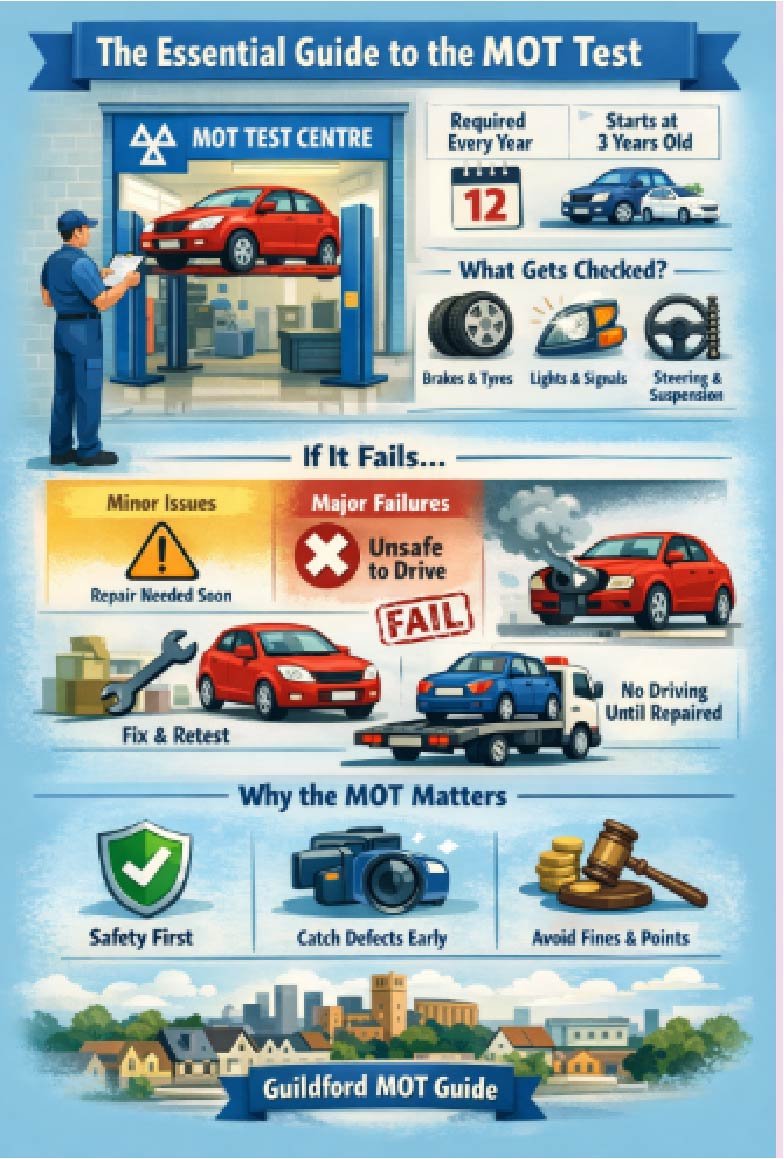
Most drivers know they need an MOT test every year. Far fewer understand what it actually covers, what happens when something fails, or why skipping it is a far bigger risk than it might seem.
Whether your car is approaching its third birthday or you have recently moved to Guildford and want to understand the process better, combining your annual MOT with a full service gives you the most complete picture of your vehicle’s health. This guide covers everything else you need to know, simply and clearly.
What Does MOT Stand For?
MOT stands for Ministry of Transport. It’s the annual roadworthiness test that most UK vehicles must pass once they reach three years old. The test is regulated by the Driver and Vehicle Standards Agency (DVSA) and carried out at authorised test centres across the country.
The MOT certificate your car receives after passing, known as a VT20, confirms that on the day of the test, your vehicle met the minimum safety and environmental standards required by law. It does not mean your car will remain safe for the full year without maintenance. That responsibility sits with you as the driver.
When Does Your Car Need an MOT?
The rules around MOT timing catch more drivers out than you’d expect. Here’s how it works:
- First MOT: due on the third anniversary of your vehicle’s registration date, not the date you bought it.
- Annual renewal: required every year after that, without exception.
- Early booking: you can book your MOT up to one calendar month before it expires without losing any days on the new certificate.
- No grace period: the moment your MOT expires, it is illegal to drive the vehicle on public roads. There is no buffer, no 14-day window.
- SORN vehicles: if your car is off the road and declared SORN (Statutory Off Road Notification), you are exempt while it remains off public roads.
- Older vehicles: cars first registered more than 40 years ago, with no substantial changes in the last 30 years, are exempt from the annual test.
If you’re unsure when your car’s first test is due, or how the timing works for a newer vehicle, this complete guide to when a new car needs its first MOT explains it in full detail.
What Does an MOT Test Actually Check?
The MOT covers a broad range of safety and environmental checks. Understanding what’s included, and what isn’t, helps you arrive prepared and avoid any nasty surprises.
What’s Checked and What’s Not
| Checked in the MOT | Not Checked in the MOT |
| Brakes: pads, discs, calipers, efficiency | Engine condition and internal components |
| Tyres: tread depth, condition, sidewalls | Clutch |
| All lights: headlights, indicators, brake, fog, plate | Gearbox |
| Steering: wheel, components, power steering | Air conditioning |
| Suspension: shock absorbers, joints, bushes | General bodywork scratches or dents |
| Exhaust emissions | Infotainment or entertainment systems |
| Seatbelts: condition and function | Tyre pressure (only the TPMS warning light is checked) |
| Windscreen: chips, cracks, wiper operation | |
| Horn | |
| Mirrors: condition and adjustment | |
| Number plates: legibility and secure fitting | |
| Vehicle Identification Number (VIN) |
Key Areas Explained:
Brakes
Brakes are among the most safety-critical components on any vehicle. The tester checks pads, discs, calipers, and pipes, and also carries out a brake efficiency test to measure stopping performance. According to RAC research, brake-related issues account for one in ten MOT failures and around 34% of all advisory notices.
Tyres
Tyres must have a minimum tread depth of 1.6mm across the central three-quarters of the tyre, around the full circumference. The tester also checks for cuts, bulges, and uneven wear. Tyre-related issues account for approximately 42% of all advisory notices, the single highest category.
Lights
Every light on your vehicle is checked: headlights, sidelights, brake lights, indicators, fog lights, reversing lights, and number plate lights. Pairs of lights must emit the same colour and intensity. A single blown bulb is one of the most common, and most avoidable, reasons for an MOT failure.
Emissions
The exhaust system is inspected for security and leaks, and your vehicle’s emissions are measured using specialist equipment. The specific test varies depending on the age and fuel type of your vehicle. Electric vehicles do not have an exhaust emissions test, but all other aspects of the MOT apply to them.
Steering and Suspension
The tester checks for wear, corrosion, and damage across the steering column, joints, and suspension components. Suspension faults account for around 13% of MOT failures nationally, often in older vehicles where wear builds gradually and goes unnoticed.
Windscreen and Wipers
Any chip or crack in the driver’s zone of vision that is larger than 10mm will result in a failure. Wipers must clear the screen effectively when used with the washer fluid, running low on screenwash is a surprisingly common reason for a car to be turned away before the test even begins.
Understanding Your MOT Result
Not every MOT result is simply pass or fail. The DVSA uses four categories to describe the condition of any faults found during the inspection.
MOT Defect Categories Explained
| Category | What It Means | Can You Drive Away? |
| Dangerous | An immediate risk to road safety or the environment | No: even if your previous MOT is still valid |
| Major | A significant safety or emissions failure | No: vehicle must be repaired before use |
| Minor | A defect present but not yet a significant risk | Yes: but it should be repaired promptly |
| Advisory | A component that is wearing but has not yet failed | Yes: the car passes, but monitor it closely |
What Are MOT Advisories?
Advisories are the part of the MOT result that most drivers misunderstand. Your car passes with advisories, and you can legally drive it for another year. However, treating them as something to ignore is a real risk.
National motoring research found that one in six motorists who failed to act on advisory notices went on to experience a breakdown or collision within the following year. The same research found that 24% of UK drivers admitted to delaying repairs on an advisory specifically because of cost concerns, understandable, but potentially far more costly in the long run.
Advisories stay on your car’s MOT history permanently. Anyone checking your vehicle’s records, whether a potential buyer, a garage, or an insurer, can see them. A pattern of the same advisory appearing year after year signals poor maintenance and will affect your car’s resale value.
If you’re unsure how much an MOT itself costs, this guide to MOT costs breaks it down clearly.
Why Your MOT Matters More Than You Think
It’s easy to view the MOT as just another piece of annual admin. In reality, it’s one of the most practical safety checks your vehicle receives all year.
Road Safety
Government data shows that vehicle defects contributed to 1,350 road collisions in 2023, the highest figure in five years, resulting in 36 fatalities, also the most since 2018. The MOT exists specifically to catch the kind of gradual wear that drivers often don’t notice until something goes seriously wrong.
Roads around Guildford and across Surrey carry a significant volume of daily commuter and commercial traffic. A car with worn brakes or degraded suspension handles very differently on a wet A3 or during a sudden stop on a town centre road. The MOT gives you a structured annual check that your car is genuinely fit for those conditions.
Insurance Implications
A failed MOT does not automatically invalidate your insurance policy. However, if you continue to drive a vehicle with unresolved faults, particularly dangerous ones, and are involved in an accident, your insurer may refuse to pay out. The basis for refusal is typically that you knew the vehicle was not roadworthy and drove it anyway. That distinction matters enormously.
Ignoring advisories carries a similar risk. If a neglected advisory, such as a tyre approaching its legal limit, is found to have contributed to a collision, the insurance implications can be severe.
Resale Value and Buyer Confidence
A full, unbroken MOT history is one of the first things a careful buyer checks when purchasing a used car. A clean record with few advisories signals a well-maintained vehicle. A history full of repeated advisories, or gaps in the record, raises immediate questions about how the car has been looked after.
Peace of Mind
There is genuine value in simply knowing your car is safe. A full car service combined with your annual MOT gives you the most complete picture of your vehicle’s health, covering systems the MOT doesn’t inspect, such as the engine, clutch, and fluid levels. For many drivers in Guildford, combining the two in a single visit is the most practical and cost-effective approach.
Five Simple Checks to Do Before Your MOT
Many MOT failures come down to small, easily avoidable issues that take minutes to check at home. Running through these before your test can save you the cost and inconvenience of a retest.
- Check all lights: Walk around the car with a friend. Test the headlights on full and dipped beam, both indicators, brake lights, fog lights, reversing lights, and number plate lights. Replace any blown bulbs before the test.
- Check your tyre tread: Use the 20p coin test. Insert a 20p coin into the tyre’s main tread grooves. If the outer band of the coin is visible, the tread is below the legal limit and the tyre will fail. Also check for cuts, bulges, and uneven wear across the tyre surface.
- Top up your screenwash: This one catches drivers out every year. If your washer fluid is empty, the tester may refuse to carry out the test at all. Top it up the night before.
- Check your horn: Give it a quick press. It must produce a clear, continuous note loud enough for other road users to hear. If it’s intermittent or silent, it will fail.
- Clean your number plates: Number plates must be clearly legible. A dirty or cracked plate can result in a failure. While you’re at it, make sure the plate is securely attached and not missing any fixings.
Conclusion
The MOT test is not just a legal box to tick once a year. It is a structured safety check that protects you, your passengers, and every other person sharing the road with you. Understanding what it covers, what the results mean, and how to prepare for it makes the whole process far less stressful, and keeps your car in the condition it needs to be in.
If your MOT is coming up soon, or you’ve recently received advisories you’re unsure about, the team at PG Village MOT in Guildford is here to help. Straightforward, honest advice and a thorough test every time.
Frequently Asked Questions
What does MOT stand for? MOT stands for Ministry of Transport. It is the annual vehicle roadworthiness test required by law in the UK for most vehicles over three years old, regulated by the Driver and Vehicle Standards Agency (DVSA).
When does my car need its first MOT? Your car’s first MOT is due on the third anniversary of its original registration date. After that, it must be tested every year to remain legal on public roads.
What happens if my car fails its MOT? You will receive a list of faults categorised as dangerous, major, or minor. Dangerous or major faults mean the car cannot be driven until repaired. If your previous certificate is still valid and no dangerous faults are recorded, you may drive to a repair garage. A partial retest is available at no extra charge if repairs are completed within 10 working days at the original test centre.
Can I drive my car without a valid MOT? No, with one exception. You may drive directly to a pre-booked MOT appointment, providing your vehicle is in a roadworthy condition. Driving without a valid MOT otherwise risks a fine of up to £1,000, a prohibition notice, and potentially invalidated insurance.
What are MOT advisories and do I need to act on them? Advisories are warnings about components that are wearing but have not yet reached the point of failure. Your car passes the MOT with advisories. However, ignoring them is risky. RAC research shows that one in six drivers who ignored advisories experienced a breakdown or collision within the year.
What does the MOT not cover? The MOT does not inspect the engine condition, clutch, or gearbox. It is a snapshot of roadworthiness at the time of the test, not a substitute for a full annual service.
How do I check when my MOT is due? You can check your MOT due date for free on the GOV.UK vehicle enquiry service using your registration number. Unlike road tax, the DVSA does not send automatic reminders, so it is worth making a note well in advance.