


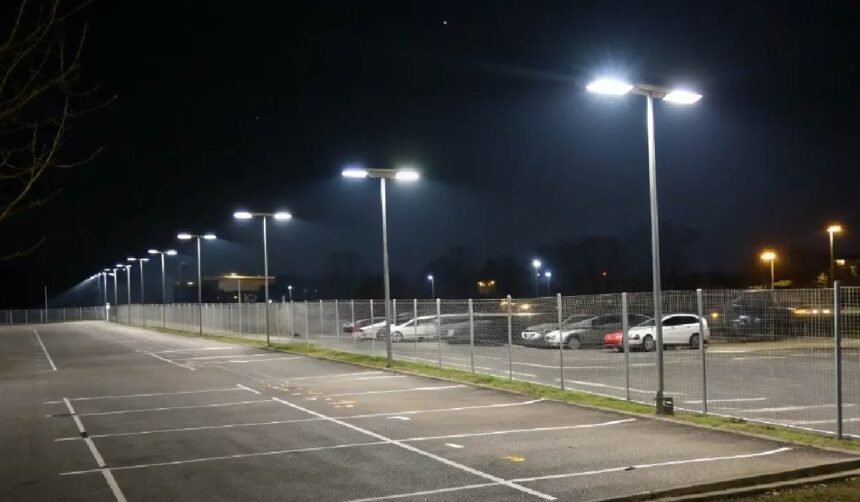
LED shoebox lights are outdoor fixtures mounted on poles or walls. They illuminate parking lots, streets, and large outdoor areas. The name comes from their rectangular shape. This shape resembles a shoebox.
These fixtures use LED technology instead of older metal halide or sodium vapor bulbs. They consume 50-70% less electricity. They last 50,000 to 100,000 hours. Traditional fixtures last 10,000 to 20,000 hours.
How LED Shoebox Lights Work
LED shoebox lights contain multiple light-emitting diodes. These diodes create the light. They arrange in specific patterns inside the fixture. The arrangement controls light direction and spread.
A lens covers the diodes. This lens protects them from weather. It also shapes the light beam. The lens material must resist UV damage and temperature changes.
Heat management matters most for LED performance. Diodes generate some heat. This heat escapes through an aluminum base. The base acts as a heat sink. Proper heat removal keeps diodes working longer.
A power supply converts electricity into the right voltage. Most LED shoebox lights run on standard 120V or 277V power. Some run on 480V three-phase power used in industrial sites.
Key Technical Specifications
LED shoebox lights vary in power consumption based on application needs:
- 50-watt models: 5,000-7,000 lumens. Used for small parking areas
- 100-watt models: 10,000-13,000 lumens. Standard for medium parking lots
- 150-watt models: 15,000-19,000 lumens. Large parking areas and streets
- 200-watt models: 20,000-26,000 lumens. Major highways and industrial sites
- 300-watt models: 30,000+ lumens. Very large facilities
Color temperature affects visibility. Most outdoor lighting uses 4000K to 5000K. This range provides good visibility at night. It appears white or slightly cool to human eyes. Lower temperatures (3000K) look more yellow. Higher temperatures (6500K) look more blue.
Lumens measure total light output. Lux measures light intensity at a specific distance. A 100-watt LED shoebox light produces roughly 10,000-13,000 lumens. The same light covers 2,000-3,000 square feet of parking lot effectively.
Real-World Performance Data
LED shoebox lights outperform older technologies by measurable amounts. A 100-watt LED fixture produces equivalent light to a 400-watt metal halide bulb. This comparison drives energy savings.
Electricity costs vary by location. Average US rates run $0.12-0.16 per kilowatt-hour. A 100-watt LED fixture running 4,000 hours yearly costs about $48-64 in electricity. A 400-watt metal halide costs $192-256. Annual savings reach $128-192 per fixture.
Large parking lots contain 20-100 fixtures. A 50-fixture lot saves $2,560-9,600 yearly. Over 10 years, this totals $25,600-96,000 in energy costs avoided.
Maintenance costs drop significantly. LED fixtures need replacing every 10 years based on lifespan. Metal halide fixtures need replacing every 2-3 years. Labor costs for replacement average $100-200 per fixture. A 50-fixture parking lot saves $4,000-10,000 in labor over 10 years.
Payback Calculations
Initial cost for LED fixtures runs $300-600 per unit. Metal halide fixtures cost $150-250. The difference is $150-350 per fixture.
A 50-fixture lot costs $7,500-17,500 more upfront for LED. However, energy and maintenance savings average $3,500-4,000 yearly. Payback occurs in 2-5 years. The fixture operates for another 5-10 years with no additional major costs.
Many utilities offer rebates. These rebates reduce upfront cost by $50-200 per fixture. Some jurisdictions offer tax credits of 30% of total installation cost.
Where LED Shoebox Lights Get Installed
Parking lots are the most common application. They need uniform, bright lighting for safety. Visibility reduces accidents and crime.
Street lighting uses LED shoebox lights for highways and residential roads. Municipal departments save 50% of street lighting budgets by switching to LED. A typical city with 10,000 street lights can save $500,000-1,000,000 annually.
Industrial facilities use them for warehouse exteriors, loading docks, and property perimeters. Bright, consistent light improves worker safety. It deters theft and security incidents.
Retail parking lots prioritize safety and visibility. Crime rates drop in well-lit areas. Customer comfort increases. This translates to increased visits and sales.
Educational campuses use LED fixtures on parking areas and walkways. Student safety improves. Operating budgets decrease.
Installation Considerations
Pole height determines light spread. A 20-foot pole with a 100-watt fixture covers roughly 2,000 square feet. A 30-foot pole with the same fixture covers 4,000-5,000 square feet. Higher poles need higher wattage for equal brightness.
Fixture spacing matters. Fixtures spaced 150-200 feet apart create uniform lighting. Spacing too far apart creates dark spots. Spacing too close wastes money.
Electrical infrastructure must support LED lights. Existing wiring usually works fine. Power supplies handle standard voltages. Some old systems use photocells. These turn lights on at dusk and off at dawn.
Motion sensors add value to some applications. They cut power when no motion occurs. This reduces energy use by 30-50% in low-traffic areas. Warehouses and perimeter lighting benefit most.
Comparison With Other Lighting Types
Metal halide lamps were standard for 40 years. They produce good light but consume enormous power. They require 5-10 minutes to reach full brightness after turning on. Bulbs must be replaced every 2-3 years. Ballast replacements add cost.
High-pressure sodium lights use even more power than metal halide. They produce orange/yellow light unsuitable for color-sensitive applications. Visibility is poor for identifying vehicles or people. These are now obsolete for most uses.
Halogen lights are rarely used for outdoor area lighting. They produce excessive heat. They waste electricity. They require frequent replacement.
LED shoebox lights eliminate these problems. They turn on instantly. They last 50,000+ hours. No ballasts or ignition systems fail. No color rendering issues exist.
Maintenance Requirements
LED shoebox lights need minimal maintenance. A visual inspection every 6 months catches problems early. Check for cracks in the lens. Look for moisture inside the fixture. Verify the lens is clean.
Lens cleaning happens annually. Dust and dirt reduce light output by 10-20%. Use soft brushes and mild soap. Avoid harsh chemicals that damage the lens coating.
Electrical connections should be checked annually. Look for corrosion around the power terminal. Verify mounting bolts are tight. Ensure no water enters the fixture.
LED diodes rarely fail. When they do, replace the entire fixture. Individual diode replacement is not practical. Fixture cost is typically the only major expense after installation.
Summary
LED shoebox lights deliver measurable benefits. Energy costs drop 50-70%. Maintenance drops 80%. Light quality improves. Lifespan extends to 50,000+ hours.
Initial cost is higher than older fixtures. Payback occurs within 2-5 years. Ongoing savings continue for 10+ years beyond payback.
Installation on poles or walls is straightforward. Existing electrical infrastructure usually works. Motion sensors and photocells add flexibility.
For parking lots, streets, and industrial areas, LED shoebox lights are the proven choice. They save money. They improve safety. They reduce environmental impact.