



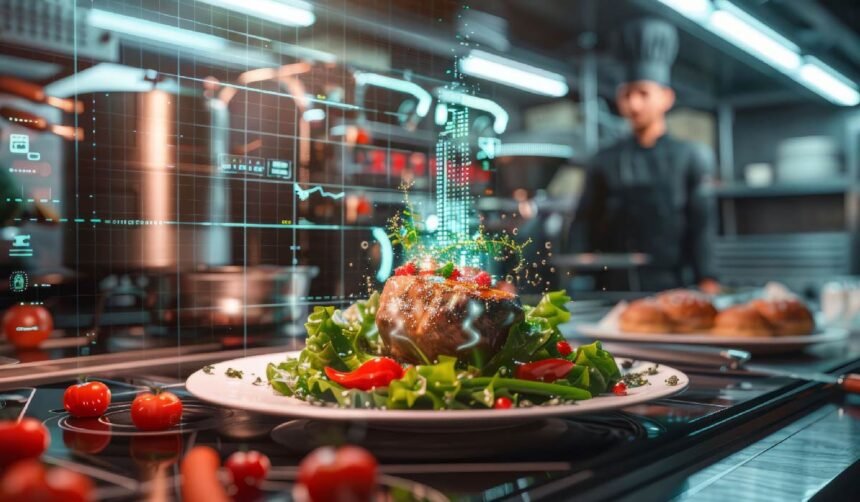
It has impacts on customer interactions, marketing, prices, manpower, menus, and procurement policies. Many restaurant owners had a problem embracing AI because they appreciated innovation for its own sake. Because labour is unreliable, margins are limited, and customer expectations are constantly rising, they adopted it. AI joined the restaurant industry as a means of survival and remained there because it produced quantifiable outcomes.
This change took time to occur. That capability was provided by AI systems. These days, machine-driven automation or prediction is used by even small independent businesses. From early morning preparation to late-night reporting, the business is impacted by these fluctuations.
Purchasing, Labour Planning, and Forecasting
The dining room was not the first area where AI altered restaurant management. Long before customers noticed any changes, the back office was data-driven. Contemporary forecasting methods examine past sales, weather information, local events, holidays, school calendars, and even traffic patterns. Managers now get anticipated sales by hour and by menu category rather than placing orders based on gut feeling.
Purchase decisions are directly impacted by forecasting. A system modifies ingredient suggestions if it anticipates a 20% decrease in foot traffic as a result of severe rain. The algorithm predicts increased beverage sales if a big concert is planned in the area. This lowers waste and overordering. In the past, food waste was determined by guessing and manual tracking. These days, AI algorithms track ingredient usage in real time and identify irregularities. The algorithm indicates either increased demand or potential inventory shrinkage if chicken usage exceeds projections.
Additionally, the labour schedule was altered. AI systems assess historical staffing trends and link them to service speed and sales volume. Schedules that minimise overstaffing during slack times and avoid understaffing during peak hours are provided to managers. These systems also take labour cost targets, overtime regulations, and personnel availability into consideration. AI is used by restaurants with significant employee turnover to forecast burnout risk based on shift patterns and hours worked.
Additionally, accounting procedures are now computerised. AI-driven systems find differences between purchase orders and invoices. Managers are notified of odd pricing increases rather than having to manually go through piles of supplier invoices. Menu changes can be made more quickly when rising ingredient costs become more apparent.
Tighter control is the outcome. Compared to five years ago, restaurants now run with greater precision. Data patterns derived from thousands of transactions are now used to make decisions that were previously based on experience.
The Menu as a Product of Data
Customers hardly notice how AI changed the menu. Sales statistics were formerly reviewed on a quarterly basis as part of menu engineering. Contribution margins, sales velocity, ingredient overlap, and plate cost changes are all continuously analysed by AI systems nowadays. Popularity is no longer an excuse for a dish that sells well but makes little money. Underperforming goods are promptly flagged by systems.
Certain restaurant segments are now using dynamic pricing. Time-based pricing is being experimented with by quick-service companies, who may provide targeted discounts during slow hours or raise rates somewhat during periods of high demand. Pricing is already modified by delivery systems according to location and demand.
AI has an impact on menu layout and design as well. Systems examine ordering trends and suggest placement tactics. High margin items could show up in areas of digital menus that are easier to see. Algorithms are used by online ordering systems to suggest extras based on past purchases. Related items may be promoted first for a consumer who often purchases spicy dishes.
Thousands of consumer comments are scanned using review analysing algorithms. These algorithms identify persistent grievances regarding wait times, temperature, seasoning, and portion sizes.
Practical and Ethical Issues
AI brings up real-world data privacy issues. Loyalty schemes gather comprehensive purchase data. Restaurants need to manage that information appropriately. Certain jurisdictions have regulations that mandate data security procedures and explicit consent.
Algorithmic prejudice poses a concern as well. Disparities may inadvertently result from pricing schemes that differ according to demand or region. In order to prevent unfair outcomes, restaurants require oversight.
Tools for tracking productivity and shift performance, such as the best employee monitoring software like Controlio, may have an impact on employee morale.
Automation is perceived differently by customers. Fast service and digital convenience are valued by certain diners. Others favour interacting with others. Restaurants need to select technology that complements their brand.
Considering the Future
The development of AI is ongoing. Voice ordering might become more common. Apps for restaurants may be integrated with personalized nutrition tracking. Ignoring technology might make it difficult to meet customer expectations and deal with cost pressure. The restaurant industry did not become automated. It turned analytical. AI works in the background of marketing campaigns, scheduling, and menus. It computes, forecasts, and makes recommendations. Cooking, serving, and hosting are still done by humans.