Introduction
When it comes to hardware innovation, one challenge that always seems to hold projects back is the “process selection dilemma”. Given that there are three processes of creating metal prototypes – CNC machining, metal 3D printing, and quick cast, the choice often boils down to intuition or biased opinions from only one vendor. As a result, the prototypes are more expensive, take more time to deliver, but most importantly, fail to serve as proof-of-concepts. This is caused by limiting a strategic decision to a technical one when, in reality, what matters is the goal of the validation.
The prototype serves to prove something – whether it’s form, fit, function, or the process itself. Based on the goal set, the process that should be selected is completely different and its economic order of magnitude varies greatly. The lack of a goal-oriented framework is the main reason behind inefficiency in the decision-making process. This article outlines a three-step process selection framework for making the decision a strategic one and finding the right industrial path at any point in time.
Which One Is It — Form, Fit, Function, or Fabrication?
The initial and arguably most essential step in our framework involves setting out the primary goal for your prototype. Mixing up these aims will result in the selection of the wrong technique. When you know your goal for prototyping, you’ll instantly reduce the choices and invest in addressing the highest priority technical challenges of the project. This objective-first approach is the cornerstone of a precise manufacturing experience.
l Understanding the Four Core Types of Prototype Validation: A prototype has its own specific purpose. Form validation evaluates aesthetics, ergonomics, and overall form. Fit validation makes sure there’s proper assembly and no interference with other components. Functional validation confirms the performance of mechanical, thermal, hydraulic, and electric properties of the prototype in practical terms. Fabrication validation is used to check if the prototype has adequate manufacturability, as well as the properties necessary for mass production processes. One example of misidentifying your goal is using a rough-looking yet accurate CNC part to validate a Form requirement.
l Aligning Objectives with Manufacturing Capabilities: Each manufacturing process will have its own set of natural capabilities that align with the stated objectives. Prototype CNC machining is a great option for testing the Fit capability, as it allows the creation of parts with extremely high precision and better surface finish using any solid material available. Metal 3D printing can be the best choice for complex Form and advanced Function testing, providing monolithic parts with internal cavities and lattice structures that cannot be manufactured using other processes. To understand what type of prototype should be created, one should first ask: “What question must this physical part answer for us?”
l The Outcome of Vague Objectives: Working without having a specific objective is similar to performing an experiment without a hypothesis. This leads to gathering information which either does not help or is deceptive. For instance, a team could spend extra money in using a 3D printed metal component to verify fit, but they may later realize that any deformation during the post-processing phase can affect important surfaces. Another scenario is when a team utilizes a CNC manufactured part for validating a topology optimized component that cannot be fabricated using CNC machining techniques. Defining the validation criteria is the essential first step to avoid unnecessary costs and concentrate on mitigating risks. 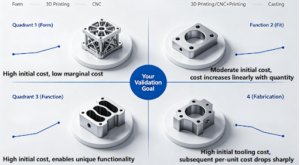
What Do Volume and Complexity “Map Out” the “Economic Terrain” for Each Process?
With the objective established, the decision-making process presents its next consideration, which is the economic reality, grounded in volume and geometric complexity. The assumption that economics can be defined simply by a “per part” measure is an extremely risky pitfall. The economic realities are uncovered through the examination of total project cost curves, which encompass more than just the cost per unit; they include setup cost, tooling, and iteration efficiency.
1. Identifying the Cost Structure of Each Process
Every process exhibits unique characteristics in terms of its cost-volume curve. The cost of CNC machining prototyping process, on one hand, may be relatively cheaper during programming, while the cost of manufacturing increases linearly based on the machine’s running time. On the other hand, the metal 3D printing process costs relatively high when preparing the data and setting up the machine, although the cost per part decreases less rapidly as more parts get manufactured within one cycle. In addition, metal casting prototyping process costs relatively high during tooling/mold, but the cost per part reduces significantly after covering these fixed costs.
2. The Significance of Part Complexity and Iteration Requirement
The impact of complexity on the economic situation is huge. The fabrication cost of a simple bracket can be lower than that of 3D printing using a computer numerical control (CNC) process even when produced in smaller quantities. But the production of a part with complex inner structures or organic geometries might be too expensive to manufacture using CNC, leaving no other choice but to use 3D printing, irrespective of the quantity. The necessity to iterate the design rapidly will also prefer the process with a reduced NRE cost.
3. Taking the Volume Strategy Decision
The model helps one take the correct volume-based strategy. For between 1-2 units of the intricate part, it may be cheaper to apply 3D printing technology. For between 5-50 units of a simpler design, it will be cheaper to use CNC machining. However, for more than 20-50 units when the aim of production is to cast, then rapid casting will be the best option. Through such a strategic decision-making process and financial analysis, one avoids the pitfall of committing to a high-volume method for low volumes, or the other way round.
Implementation of the Framework: “Material Performance” Validating Case Study
Theory becomes reality in application. Apply the framework to an actual problem: the fatigue performance validation of a novel turbine aircraft bracket of Ti-6Al-4V composition. This particular case study shows the connection between the interrelated elements of objectives, materials, and quality, which leads to the choice of a certain, appropriate option.
1. Step 1: Defining the Validation Objective
The main purpose here is obviously Functional validation, in particular, fatigue life when subjected to dynamic loads. Other purposes can be Fit of the mounting interface(s). The stated purpose clearly gives primacy to manufacturing processes that are able to produce parts with material qualities and internal soundness matching those of the final product. Aesthetic Form is a lower priority.
2. Step 2: Analysis of Materials and Quality Requirements
Materials are specified as aerospace-quality Ti-6Al-4V. Fatigue testing is crucially tied to the microstructure and lack of any defects within the material. This requirement evaluates every method used. While CNC machining of pre-forged material results in excellent materials, it might be restricted due to geometric limitations. While SLM/DMLS allows for the production of the complex geometry, it requires HIP and heat treatment to reach the same level of density and material quality as the wrought material. Casting as a prototyping method would not be able to meet requirements.
3. Step 3: Technical and Economic Integration
Taking into account the complexity of geometry (most probably a complex and light structure), a small number of prototypes (1 to 5 samples), and high requirements, two approaches may be considered as the best according to the framework: 1) high-accuracy 5-axis machining from a solid titanium blank, recommended in case the part is machinable; and 2) metal 3D printing service (using selective laser melting and hot isostatic pressing) and then finishing the most important surfaces with precise machining. It all depends on the particular machinability of the design. And for those who wish to learn more, a detailed source regarding the issue of rapid prototyping metal parts can be found here.
What Makes Hybrid Manufacturing the Best Choice?
The highest level of implementation of the decision-making model involves the understanding that the best answer may involve not only one manufacturing technology but a combination of several. Hybrid manufacturing is a manufacturing process that uses two or more processes, which helps exploit their strengths and offset their weaknesses. This technique stands at the peak of manufacturing process selection strategies and may provide better results in terms of efficiency, costs, and speed compared to the individual method.
1. The Idea of Complementing Additive Manufacturing and Subtractive Manufacturing
A typical example of hybrid manufacturing technology includes the combination of metal 3D printing and CNC machining. In this case, additive manufacturing technologies are applied to produce parts with intricate inner features, conformal cooling passages, and lattices that cannot be machined. The “roughed-out” part is sent to the CNC milling machine, where its critical surfaces are finished to a high level of accuracy, threads, and mating surfaces are cut. Thus, this hybrid manufacturing strategy allows for unlimited design possibilities with industrial-level accuracy where it really matters.
2. Hybrid Casting for Process Validation
The hybrid casting for process validation technique combines the use of 3D printed sand molds to fabricate prototypes of the casting with further precision machining using a CNC process. Here, the 3D printed part itself will allow you to validate the entire process of manufacturing, gating, and feedability. Then, the fabricated part will be finished using CNC machining to produce a highly accurate prototype, representing not only shape but also material properties of the actual product.
3. Proper Implementation Maximizes Benefit
In order to maximize the benefits of the hybrid process implementation, you need a reliable partner with a comprehensive range of services and experience in project management. The seamless nature of passing your part through two manufacturing stages with a consistent datum system is key here. If done correctly, the hybrid manufacturing process resolves issues that were previously unsolvable, speeds up your development, and drastically reduces costs.
Why Does Your Prototype’s Credibility Not Rely Only on Its Machine’s Specifications?
A prototype does not refer merely to a physical item; it is a source of information for making important decisions concerning its use. The accuracy and validity of that information (reports on dimensions, material certification, mechanical tests) depend on the controlled process that generated the data. An investment in a prototype resulting from an uncontrolled and undocumented process is a risky business since such data could potentially be considered invalid regardless of the sophistication of the machines involved.
1. The Importance of Quality Management Systems in Validating Test Data
ISO 9001 and other quality certifications such as IATF 16949 (automotive) or AS9100D (aerospace) are not just labels of quality on products; they represent the control of processes. These standards demand that production processes be documented and controlled right from the stage of acquiring materials to storage, calibration of machines, qualification of operators, and finally, inspection. Therefore, a prototype made as per any one of these quality management systems will have process parameters that are fully known, able to be repeated, and traced from the initial raw materials right through to manufacturing.
2. Inspection, Documentation, and the Digital Thread
Any credible prototype will have a compliance kit with it. This includes the First Article Inspection (FAI) report demonstrating dimensional conformity to the CAD, material certificates from the mill or for the printed/cast material, and possibly results of non-destructive testing (NDT) such as X-ray. The documentation of all these reports is part of the certification procedure carried out by the supplier, forming a digital thread of evidence. It is invaluable for audit purposes and for establishing the credibility of the prototype itself.
3. Managing Risk in the Innovation Process
The prototype development stage involves a considerable amount of time and money investment on behalf of the innovation teams. Having a partner who works in a certified framework is the best insurance against unforeseen circumstances in the manufacturing process. They ensure that any abnormalities in the process can be studied further and thus help in establishing that the data provided by the prototypes is credible enough to be relied upon and make bold moves in designing.
What Are Some Ways to Work with a Prototyping Vendor Who Serves as Your Decision-Support Engineer?
Lastly, you need a partner whose way of doing business reflects the framework in practice. The perfect vendor does not operate purely as a job shop but more as a decision-support engineer. Right from the start, they should use the logic of the framework by asking about your objectives, assessing the geometry for trade-offs economically, and offering data-based comparisons of alternatives instead of selling a particular technology. Working with this type of partner makes for a truly collaborative risk-reduction strategy.
- Testing the Consultative Approach and Advising on Objectives: As part of the vetting process, describe your challenge and project goal to the potential supplier. A partner should probe your validation objective, volume needs, performance specifications, and the part’s end-use application. They should be able to explain not only how they can help but also why one process may be superior to another in your situation. They should be willing to conduct a DFM analysis and even suggest design changes in order to optimize manufacturability through several technologies.
- Insisting on Transparency and Cost-Effective Recommendations: Ask for a comparative assessment of the situation from your side. A good supplier will be happy and ready to provide detailed quotes or feasibility studies for several different suitable processes (such as CNC machining, 3D-printing, casting). These quotes have to contain explanations of price structures and timeframes as well as associated trade-offs. This information makes it possible for you to use the decision matrix and cost calculations. Refrain from working with partners that provide just one quote that is not explained. They clearly are more interested in closing the deal than in providing any kind of consultation.
- Creating a Long-Term Strategy: The final step consists of establishing a long-term alliance and finding a business partner for the selection process. The ideal supplier will be able to assist you all the way from the very first prototypes to low-volume production runs. They can help you mitigate the risk along the road to successful mass production of the product. Working with a partner that provides custom prototype manufacturing solutions ensures that your team can tap into a wealth of manufacturing knowledge and expertise.
Conclusion
Given today’s fast pace of product development, the success of metal prototypes directly depends on how scientific the selection process of technologies was carried out. Thanks to an innovation strategy focused on validation goals while being economically oriented and quality system-based, an innovation team can overcome selection anxiety effectively. In doing so, the prototyping process will turn into an innovative “value center” rather than an obscure “necessary cost center.” The key is to ensure that prototypes provide maximum benefit, decrease risks for future development, and substantially speed up the process of moving from conception to a reliable end result.
FAQs
Q: Our prototype requires us to have something that looks like the final product, but the shape of the component is relatively complicated. What should we use then?
- In cases where you want to have a good fidelity of the prototype with respect to the final product’s shape, and you have some complications related to the geometry, metal 3D printing solutions, such as SLM, may be much better suited. Post-machining can provide great aesthetic results. However, sometimes CNC machining will require cutting the part into several pieces.
Q: How accurate are the cost curves that you have referred to? Our volumes are quite small (1-3 pieces).
- The shape of the cost curves is pretty much right, although the exact crossover point will be determined by the design and the materials used. For 1-3 pieces, CNC machining prototyping is typically the most cost-effective solution since its initial costs are lower than those of additive manufacturing and casting. Highly complex internal geometries can be only be fabricated by 3D printing. You will be able to get the exact figures and make an informed choice only after you ask for a comparative quotation for your part.
Q: We are going to cast the part for volume production. Should we use the casting method also for prototyping?
- If one of your main objectives is “Fabrication” validation (process check), then prototyping with metal casting by means of rapid tooling (such as 3D-printed sand mold technology) is highly recommended. It allows identifying possible defects in casting and optimizing the process. If the only purpose of prototyping is to validate its functionality, then CNC machining or 3D printing from the production alloy will suffice.
Q: How can I determine whether my metal 3D printing prototype is high-quality?
- Besides doing visual inspections, ask the provider for reports, including density, materials, and mechanical tests. Check for consistency in surface finish and fine resolution. In cases where it is important, you can also examine internal integrity using X-ray or CT scans for porosity. A reliable provider will give you all this information as part of their QA process.
Q: What is the biggest pitfall that most people make when choosing a prototype provider?
- The biggest pitfall is choosing the cheapest provider based on their prices. Ideally, the best provider for rapid prototyping service selection acts as a consultant who asks about your objectives, explains process trade-offs, and provides data-backed comparisons. Engineering collaboration at this early stage helps avoid any mistakes later and ensures that your prototype provides the best value for money.
Author Bio
An author skilled in the domain of rapid prototyping and manufacturing, with expertise in applying systematic approaches and utilizing effective decision making mechanisms. The author works in close coordination with the LS Manufacturing team to ensure that clients can effectively overcome the challenging phase of prototype validation, thereby facilitating mass production. Get your free comparison analysis to determine how them can help you achieve your goals with metal parts by uploading your drawings and objectives.