



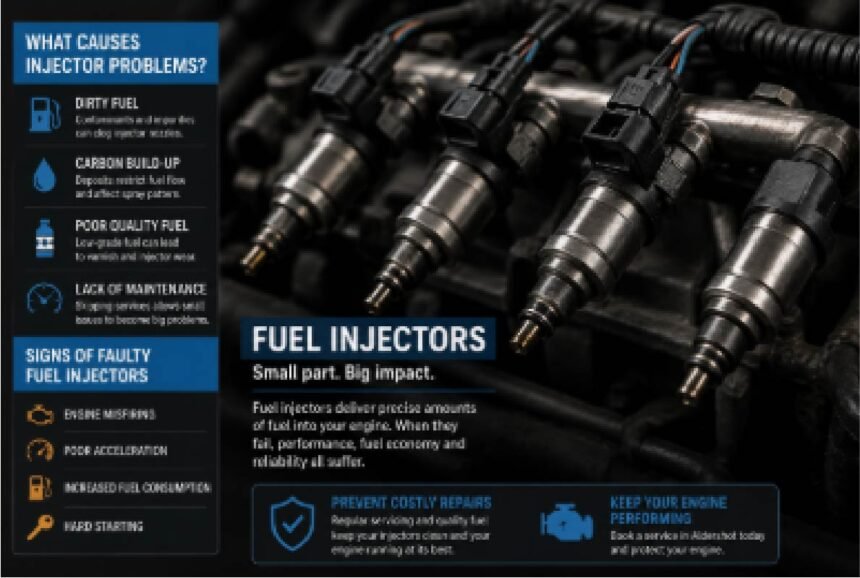
Fuel injectors are one of those components most drivers never think about until something goes wrong. They sit quietly inside your engine, delivering precise bursts of fuel into the combustion chamber thousands of times per minute. When they work well, your car runs smoothly. When they start to fail, the effects ripple through your entire engine.
If your car has been feeling sluggish, drinking more fuel than usual, or struggling to start, the fuel injectors could be at the root of it. Understanding what causes these problems in the first place is the smartest way to avoid expensive repairs and keep your engine performing as it should. If you are due a check-up, a car service in Aldershot can identify injector issues before they escalate.
How Fuel Injectors Actually Work
Before diving into the causes, it helps to understand what fuel injectors are doing inside your engine. Each injector is an electronically controlled valve that opens and closes at incredibly high speed. It sprays a fine mist of fuel directly into the combustion chamber or intake manifold, depending on the engine type, at exactly the right moment and in exactly the right quantity.
The engine control unit manages the whole process, calculating how much fuel is needed based on throttle position, engine temperature, airflow, and dozens of other variables. When the injectors are clean and functioning correctly, the fuel burns efficiently. When something disrupts that process, performance drops, emissions rise, and problems begin.
The Most Common Causes of Fuel Injector Problems
1. Clogged or Dirty Injectors
This is by far the most frequent cause of injector issues. Over time, fuel deposits, varnish, and carbon build up inside the injector nozzle. These deposits are left behind when the engine is switched off and residual fuel evaporates, leaving a sticky residue that accumulates with every cycle.
The result is a partially blocked nozzle that disrupts the spray pattern. Instead of a fine, even mist, you get an uneven stream that does not burn cleanly. This leads to:
- Rough idling and engine hesitation
- Increased fuel consumption
- Misfires under acceleration
- Higher exhaust emissions
Using lower-quality fuel regularly speeds up this process considerably. Short journeys that never fully warm the engine also contribute, as the injectors never get hot enough to burn off light deposits naturally.
2. Worn or Damaged Injector Seals and O-Rings
Each injector is sealed against the fuel rail and the engine block using rubber O-rings and seals. These components are exposed to extreme heat cycles and fuel chemicals day after day. Over time they harden, crack, and shrink.
When a seal fails, fuel can leak externally around the injector body or internally into the intake manifold. External leaks are a fire risk and will trigger a strong petrol smell inside or around the engine bay. Internal leaks cause a fuel-rich mixture that damages catalytic converters and raises emissions sharply.
This is a repair that should never be delayed. A routine MOT in Aldershot will flag emissions failures that are often traced back to injector seal deterioration.
3. Poor Fuel Quality and Contaminated Fuel
The fuel you put in the tank has a direct impact on injector health. Fuel that contains excessive water, sediment, or microbial contamination will coat and corrode injector internals over time. Water in the fuel system is particularly damaging because it causes rust within the injector and disrupts the electrical components that control the valve.
Sediment from the bottom of poorly maintained storage tanks can also find its way into your fuel and pass through a weak or aged fuel filter directly into the injectors. Once particles enter the precision-machined channels inside an injector, damage is almost inevitable.
Keeping up with fuel filter replacements is one of the most straightforward ways to protect your injectors.
4. Electrical Faults and Wiring Issues
Modern fuel injectors are solenoid-operated, meaning they rely on precise electrical signals from the engine control unit to open and close. If the wiring harness to an injector becomes corroded, loose, or damaged, the injector will not receive the correct signal and may fire at the wrong time, not at all, or stay permanently open.
A permanently open injector floods the cylinder with raw fuel. This washes oil from the cylinder walls, causes misfires, and in severe cases can cause engine damage. Electrical faults of this kind are often overlooked because the symptoms mimic other engine problems, making accurate diagnostic scanning essential.
5. Failing Fuel Pressure Regulator
The fuel pressure regulator controls the pressure at which fuel is delivered to the injectors. If it fails or begins to malfunction, the injectors receive fuel at either too high or too low a pressure.
Too much pressure forces excess fuel through the injectors, causing a rich mixture, black smoke from the exhaust, and poor fuel economy. Too little pressure starves the injectors and produces a lean mixture that causes hesitation, loss of power, and potential engine damage over time. Either scenario places stress on the injectors themselves and accelerates wear.
6. Heat Soak and Thermal Stress
Fuel injectors sit in a hot environment. When you switch your engine off after a long drive, heat continues to radiate from the engine block and exhaust components. This post-shutdown heat, often called heat soak, raises temperatures around the injectors significantly.
During heat soak, any residual fuel in the injector tips can vaporise and leave hard carbon deposits directly on the nozzle. This is one of the primary reasons modern high-pressure direct injection engines tend to develop injector deposit problems faster than older port injection systems.
Engines that run a lot of short trips in stop-start conditions, such as urban driving around Aldershot, are particularly vulnerable because the engine rarely reaches the sustained temperature needed to manage these deposits naturally.
Warning Signs Your Fuel Injectors Are Struggling
Catching injector problems early saves money and prevents secondary damage to other engine components. These are the symptoms worth paying attention to:
- Rough or lumpy idle: the engine shakes or feels uneven when stationary.
- Engine misfires: a juddering sensation during acceleration or at cruising speed.
- Poor fuel economy: filling up more often without changing your driving habits.
- Difficulty starting: especially on cold mornings or after the car has been sitting.
- Strong fuel smell: a petrol odour inside or around the engine bay.
- Black smoke from the exhaust: a sign of unburnt fuel passing through the system.
- Check engine light: modern engine management systems flag injector faults quickly.
Any one of these symptoms on its own warrants investigation. Several appearing together strongly suggest an injector issue that needs professional attention without delay.
How Injector Problems Affect the Rest of Your Engine
Fuel injector faults rarely stay contained to the injectors alone. The knock-on effects can reach several other components, particularly if the problem is left unaddressed.
A rich-running engine caused by leaking or stuck-open injectors will wash the oil film from cylinder walls. This accelerates piston and bore wear far beyond the normal rate. The excess unburnt fuel also contaminates the engine oil, reducing its viscosity and compromising its ability to lubricate correctly.
Catalytic converters suffer badly from injector problems. They are designed to handle small amounts of unburnt hydrocarbons, but a consistently rich mixture will overheat and destroy the catalytic substrate within a relatively short time. Replacing a catalytic converter is significantly more expensive than resolving an injector fault early.
Spark plugs are another casualty. Fuel deposits coat the electrode, causing fouling that leads to misfires and further incomplete combustion. Understanding how your car’s overall mechanical systems interact is worth reading about. The complete guide to car suspension systems is a good example of how interconnected vehicle components really are.
Can You Prevent Fuel Injector Problems?
The straightforward answer is yes, at least to a significant degree. Most injector problems are gradual and preventable with consistent maintenance habits.
Use quality fuel. Fuel from reputable forecourts is refined to tighter standards and contains fewer contaminants. The difference in injector deposits over time between good and poor quality fuel is measurable.
Change your fuel filter on schedule. A clogged fuel filter forces the injectors to work harder and allows finer particles to reach the nozzle tips. Most manufacturers recommend replacement every 30,000 to 40,000 miles, though some modern vehicles have longer intervals.
Avoid excessive short journeys. Short trips mean the engine never reaches optimal temperature. This prevents the natural cleaning effect that comes with sustained running and accelerates deposit build-up on the injectors.
Use a reputable fuel injector cleaner periodically. Added to the fuel tank at the recommended interval, these products dissolve light varnish deposits inside the injectors and fuel lines. They are not a substitute for professional cleaning but are a useful preventive measure.
Keep up with scheduled servicing. Regular servicing means a trained technician checks fuel system components, scans for fault codes, and catches developing problems before they become costly ones.
Professional Injector Cleaning vs Replacement
When an injector is diagnosed as faulty, the decision between cleaning and replacement depends on the nature and extent of the problem.
Professional ultrasonic cleaning is highly effective for blocked injectors. The injector is removed and placed in an ultrasonic cleaning machine that uses high-frequency vibrations in a cleaning fluid to dislodge and remove deposits. Flow rates and spray patterns are tested before and after to confirm the cleaning has been successful.
If the injector body is cracked, the solenoid has failed electrically, or the internal valve is damaged beyond cleaning, replacement is the only reliable option. A single faulty injector is typically replaced rather than the full set, though some technicians recommend replacing injectors as a matched set on higher-mileage engines to ensure consistent performance across all cylinders.
Conclusion
Fuel injector problems are almost always the result of gradual deterioration rather than sudden failure. Contaminated fuel, accumulated deposits, heat stress, worn seals, and electrical faults are the core causes, and all of them are manageable with the right maintenance approach.
The engine in your car depends on precise fuel delivery to run efficiently and cleanly. Ignoring early warning signs rarely ends well. A rough idle today can become a misfiring engine next month and a damaged catalytic converter shortly after that.
Staying ahead of injector problems through regular servicing, quality fuel, and timely repairs is far more cost-effective than dealing with the secondary damage that follows neglect. If you have noticed any of the symptoms described in this article, it is worth having your fuel system checked by a qualified technician who can give you an accurate diagnosis and the right solution.
Frequently Asked Questions
What are the first signs of a failing fuel injector? The earliest signs are usually a rough idle, slight hesitation when accelerating, and a modest increase in fuel consumption. These symptoms can be subtle at first but tend to worsen gradually if the underlying problem is not addressed.
Can dirty fuel injectors cause an engine misfire? Yes. A partially blocked injector delivers an inconsistent amount of fuel to the cylinder. When the fuel-to-air ratio falls outside the correct range, the mixture does not combust properly and a misfire occurs. Persistent misfires place significant stress on spark plugs and catalytic converters.
How long do fuel injectors last? In good operating conditions with quality fuel and regular servicing, fuel injectors can last well over 100,000 miles. Poor fuel quality, infrequent servicing, and prolonged short-journey driving will shorten their lifespan considerably.
Is it safe to drive with a faulty fuel injector? It is not advisable. A leaking injector presents a fire risk, and a misfiring engine can cause rapid damage to the catalytic converter, spark plugs, and cylinder walls. The longer the problem continues, the more expensive the repair is likely to become.
Will a fuel injector problem trigger the check engine light? In most modern vehicles, yes. The engine management system monitors combustion quality through oxygen sensors and other inputs. An injector fault will typically generate a fault code and illuminate the check engine warning on the dashboard.
Can I use fuel injector cleaner instead of having them professionally cleaned? Fuel injector cleaner added to the tank is useful for light, preventive maintenance and may improve performance on mildly fouled injectors. However, it is not effective on heavily blocked or mechanically damaged injectors, which require professional cleaning or replacement.