



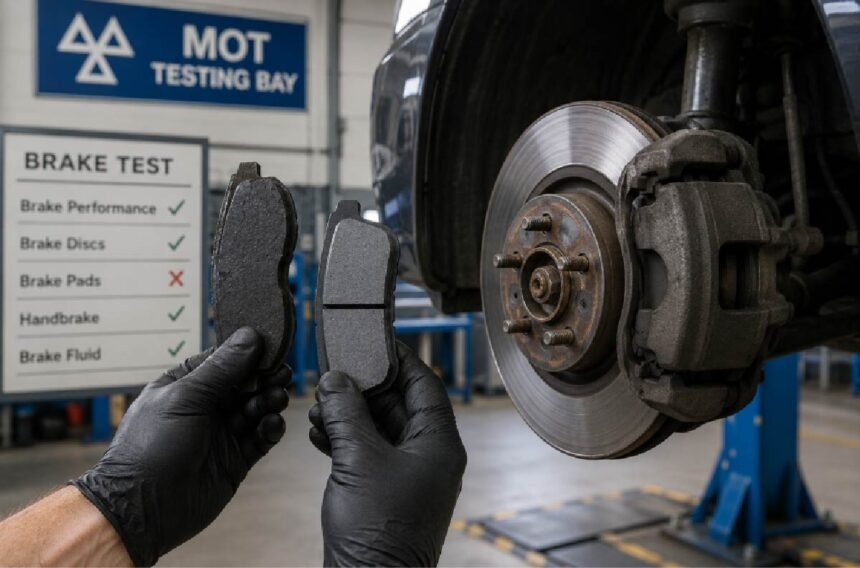
Yes, worn brake pads will cause your vehicle to fail its MOT. Under DVSA standards, brake pads must be at least 1.5mm thick to pass inspection. If they fall below this threshold, the vehicle is classed as unroadworthy and will receive an immediate fail, no exceptions.
Beyond thickness, MOT inspectors use a roller brake tester to measure braking efficiency across all four wheels. The front brakes must achieve at least 50% efficiency and the rear at least 25%. Worn pads reduce friction material contact with the disc, lowering this efficiency below the legal standard. They also trigger cascading failures, damaged brake discs, fluid leaks, ABS faults, and braking imbalance, all of which are independent MOT failure points.
If your brakes feel soft, squeal, or your dashboard is showing a warning light, don’t wait for test day. This guide explains exactly what MOT testers check, how worn your pads can be before you fail, and how to prepare your braking system for a clean pass.
What the MOT Brake Test Actually Checks
MOT testers employed at DVSA-authorised test stations examine your braking system from multiple angles. The inspection covers visual checks, mechanical condition, and live performance measurements.
- Brake Pad Thickness
Inspectors measure the thickness of your brake pads. The legal minimum is 1.5mm, but most professionals recommend replacement at 3mm to maintain safe braking performance. If your pads are at or below the legal limit, your vehicle fails immediately.
- Brake Performance and Balance
Your brakes are tested on a rolling road to measure braking efficiency. Each wheel’s braking force is measured and compared. If one side brakes significantly harder than the other, it indicates uneven wear or a mechanical fault, both of which result in failure.
- Brake Disc Condition
Worn brake pads often damage discs. Testers check for excessive scoring, cracks, or warping. Even if your pads pass, damaged discs can fail your MOT and require replacement.
- Brake Fluid and Lines
Low brake fluid, leaks, or corroded brake lines are automatic failures. Worn pads can sometimes contribute to fluid loss if the system has been compensating for reduced pad material.
- Warning Lights and Electronic Systems
Modern vehicles have dashboard warning lights for brake issues. If your brake warning light is on during the test, you’ll fail. This includes ABS warnings, as faulty sensors often relate to brake wear.
The MOT isn’t just a formality. It’s a thorough safety check, and worn brake pads create multiple failure points across these areas.
How Worn Can Brake Pads Be Before MOT Failure?
The legal threshold is clear: 1.5mm of friction material remaining. Below that, the vehicle fails immediately.
However, arriving at your MOT with 1.5mm is a false economy. At that thickness, the metal backing plate is millimetres away from direct disc contact. Braking efficiency drops sharply, stopping distances increase, and brake disc damage becomes likely within a very short mileage.
The industry-standard recommendation is replacement at 3mm. This gives you a meaningful safety margin, protects your discs, and eliminates the risk of failing the DVSA’s braking efficiency test.
What Happens When Pads Are Too Thin?
When brake pads wear below safe levels, several problems emerge. The metal backing plate begins grinding against the brake disc, creating deep grooves and weakening the disc’s structural integrity. This metal on metal contact also generates excessive heat, which can warp the disc and reduce overall braking efficiency.
Testers also assess brake balance. If one pad is more worn than the others, your vehicle will pull to one side during braking. This imbalance is a clear MOT failure and a serious safety hazard on the road.
In short, if your brake pads are hovering around 2mm or less, don’t gamble with your MOT. Get them replaced before the test.
Common Signs Your Brake Pads Are Too Worn for MOT
You don’t need to wait for an MOT to know your brake pads are failing. Your vehicle will tell you, often loudly and repeatedly. Recognising these signs early gives you time to book a service appointment and avoid MOT rejection.
Squealing or Grinding Noises
High pitched squealing is the first warning. Most brake pads include a small metal indicator that scrapes against the disc when the pad wears thin. It’s designed to be annoying, so you can’t ignore it. If you hear grinding, you’ve gone past the warning stage. The pad’s backing plate is now scraping the disc, causing damage with every stop.
Reduced Braking Performance
If your brake pedal feels spongy, travels further than usual, or requires more pressure to stop, your pads are likely worn. This happens because there’s less friction material to grip the disc. Drivers in Fleet and Farnham often notice this during stop and go traffic or on downhill stretches.
Vibrations Through the Brake Pedal
Uneven pad wear or warped discs caused by worn pads create vibrations when you brake. This pulsing sensation is a clear sign something is wrong, and it’s a problem MOT testers will spot immediately.
Dashboard Warning Lights
Modern vehicles monitor brake pad thickness electronically. If your brake warning light appears, don’t ignore it. This will result in an MOT failure, and the underlying issue, usually worn pads, needs addressing.
Visible Thin Pads Through the Wheel Look through your wheel spokes. If the pad material looks thinner than a £1 coin (roughly 3mm), replacement is due.
Why Worn Brake Pads Cause Other MOT Failures
Worn pads rarely produce a single failure. They trigger a chain of problems across the braking system, each of which is independently assessed during the MOT.
Damaged Brake Discs – Metal-on-metal contact scores and warps rotors. Damaged discs fail on condition even if the pads scrape through on thickness.
Brake Fluid Contamination or Loss – Extended calliper pistons can breach hydraulic seals. Low or leaking fluid is an automatic failure.
Braking Imbalance – Uneven pad wear across an axle creates measurable left-right imbalance on the roller tester. This fails the brake performance test.
ABS and EBD Faults – Severely worn pads can trigger sensor faults in the ABS system. Any illuminated brake warning light fails the MOT outright.
Reduced Braking Efficiency – Less friction material means lower braking force. If the system falls below the DVSA’s efficiency thresholds (50% front / 25% rear), the vehicle fails the performance test.
This is why replacing pads at 3mm, rather than waiting for the 1.5mm legal limit, is always the more cost-effective decision.
What Happens If You Fail Your MOT Due to Worn Brake Pads?
Failing your MOT because of worn brake pads is frustrating, but it’s not the end of the world. You have options, and understanding the process helps you respond quickly and get back on the road legally.
Immediate consequence: Your vehicle cannot legally be driven on public roads (except directly to a pre-booked garage for repairs). Driving with a failed MOT certificate and defective brakes risks prosecution, penalty points, and insurance invalidation.
Retest rules: Repairs completed within 10 working days qualify for a free partial retest covering only the failed items. Beyond 10 days, a full retest fee applies.
Typical repair costs:
- Brake pads only: £70–£150 per axle
- Brake pads + discs: £200–£400 per axle
- Brake fluid replacement: £30–£50
- Calliper replacement (if seized): add £80–£150
Advisory notices: If your pads pass at 2mm, expect an advisory. This is the tester telling you failure is imminent, replace them before your next MOT, not during it.
How to Prepare Your Brakes for MOT Success
These steps take minimal time and significantly reduce the risk of brake-related MOT failure.
- Visual check through the wheel: Look for friction material thickness. Anything approaching 3mm warrants replacement before your test.
- Listen during normal driving: Squealing or grinding means worn pads. Don’t dismiss it.
- Test brake feel: Is the pedal firm and responsive? Does the car stop straight? Any deviation suggests a braking fault.
- Check the dashboard: No warning lights should be illuminated before your MOT.
- Check brake fluid level: The reservoir sits in the engine bay. Low fluid often indicates worn pads or a developing leak.
- Book a pre-MOT brake inspection: A qualified technician can measure pad thickness precisely, assess disc condition, and check calliper operation before your test date. Drivers across Fleet and Hampshire regularly use this service to avoid day-of surprises.
For drivers in Fleet, Farnborough, and the surrounding Hampshire area, TJ Services offer pre-MOT brake inspections. If you need a MOT test in Fleet, Hampshire, having your brake pads professionally checked beforehand is the single most effective way to avoid a costly rejection.
When to Replace Brake Pads to Avoid MOT Failure
Timing your brake pad replacement correctly prevents MOT failures and avoids unnecessary repair costs. Knowing when to act, rather than reacting to problems, is the key to hassle free motoring.
| Pad Thickness | Action Required |
| 4mm+ | Monitor at next service |
| 3mm | Replace now, don’t wait |
| 2mm | Replace immediately before MOT |
| 1.5mm | Legal minimum, already a risk |
| Below 1.5mm | Automatic MOT fail, unroadworthy |
Replace pads in pairs per axle, always. Fitting one new pad against a worn one creates the braking imbalance that fails the roller tester.
If your MOT is within four weeks and your pads are at or below 4mm, replace them now. The cost of proactive replacement is always lower than the cost of failure plus retest plus potential disc damage.
Can You Drive on Worn Brake Pads Before Your MOT?
Technically, yes, but it’s a terrible idea. Driving on worn brake pads before your MOT puts you at risk legally, financially, and physically.
Legal risk – Pads below 1.5mm make the vehicle unroadworthy under the Road Vehicles (Construction and Use) Regulations. Police can issue fixed penalties and require the vehicle to be removed from the road.
Insurance risk – Insurers can void claims if the vehicle was in a defective condition at the time of an accident. Worn brake pads below the legal limit constitute a defect.
Safety risk – In wet Hampshire road conditions, increased stopping distances caused by worn pads can be the difference between a near-miss and a collision.
Financial risk – Every mile driven on metal-to-metal contact deepens disc damage. A £100 job becomes a £400 job.
If you suspect your pads are worn, drive directly to a qualified garage for inspection. Don’t make unnecessary journeys.
How Much Does Brake Pad Replacement Cost?
Brake pad replacement costs vary depending on your vehicle type, location, and whether additional components need replacing. Understanding typical pricing helps you budget and avoid surprises.
Standard Brake Pad Replacement
Expect to pay between £70 and £150 per axle for brake pad replacement. This includes parts and labour. Smaller vehicles with simpler braking systems sit at the lower end, while larger or performance vehicles cost more.
Brake Pads and Discs Together
If your worn pads have damaged the discs, you’ll need both replaced. This typically costs between £200 and £400 per axle. Replacing both at once is common when pads have been neglected and worn below safe levels.
Labour Costs
Labour charges in Hampshire, including garages serving Fleet, Farnborough, and Ash Vale, generally range from £50 to £100 per hour. Brake pad replacement usually takes one to two hours.
Premium vs Standard Parts
You can choose between standard, mid range, or premium brake pads. Standard pads are adequate for most drivers. Premium pads last longer and perform better but cost more upfront.
Additional Costs
If your brake fluid needs replacing, add another £30 to £50. If brake callipers or other components are worn, costs increase further.
Cost of Delaying
Delaying brake pad replacement always costs more. A £100 pad replacement becomes a £400 bill once discs are damaged, and if you fail your MOT, add retest fees on top.
Investing in timely brake maintenance is always cheaper than waiting for failure.
How Often Should You Check Your Brake Pads?
Regular brake pad checks prevent surprises and keep your vehicle roadworthy year round. Establishing a simple inspection routine takes minutes and saves you from costly failures.
Every 6,000 Miles or Six Months
Check your brake pads at least twice a year or every 6,000 miles, whichever comes first. This frequency catches wear early and allows time for planned replacement rather than emergency repairs.
Before Long Journeys
If you’re planning a long trip, especially through varied terrain, check your brakes beforehand. Worn pads perform poorly under sustained braking, such as driving through hilly areas around Hampshire.
After Warning Signs Appear
If you hear squealing, feel vibrations, or notice reduced braking performance, inspect your pads immediately. Don’t wait for your next scheduled check.
During Routine Servicing
Most garages include a brake inspection during routine servicing. If you’re booking maintenance work, ask the technician to measure pad thickness and assess overall brake condition.
Before Your MOT
Check your brakes at least a month before your MOT. This gives you time to replace worn pads without the pressure of an imminent test date.
After Heavy Use
If you’ve been driving in heavy traffic, towing, or navigating steep roads, check your pads more frequently. These conditions accelerate wear.
Consistent checks build good habits and ensure your brakes are always MOT ready.
Conclusion
Worn brake pads will cause MOT failure, and the damage doesn’t stop there. Below 1.5mm, you’re looking at disc damage, hydraulic faults, ABS alerts, and a braking efficiency reading that won’t meet DVSA standards. The test is thorough, and inspectors will find worn pads every time.
The solution is straightforward: replace pads at 3mm, not at the legal minimum. Check your brakes regularly, act on warning signs immediately, and book a pre-MOT inspection if you’re unsure.
For drivers searching for a MOT test in Fleet, Hampshire, TJ Services provide full brake inspections, pre-MOT checks, and same-day pad replacement across Fleet and the surrounding Hampshire area. Find TJ Services and get directions to book your brake inspection today.
FAQs
Can I pass my MOT with 2mm brake pads?
Technically yes, the legal minimum is 1.5mm. But 2mm provides almost no safety margin. Braking efficiency is already compromised, disc damage is likely imminent, and the tester may issue an advisory that triggers closer scrutiny. Replace them before your MOT.
What is the minimum brake pad thickness for MOT in the UK?
The DVSA requires a minimum of 1.5mm of friction material. Anything below this results in an automatic MOT failure. Most garages recommend replacement at 3mm.
How long does brake pad replacement take?
Typically one to two hours per axle, depending on vehicle type and whether discs need replacing too. Most garages can complete same-day.
Do I need to replace brake pads on both sides?
Yes. Always replace in axle pairs. Replacing one pad creates left-right braking imbalance, which fails the MOT roller brake test.
Will worn brake pads invalidate my insurance?
Yes. If your pads are below the legal limit and you’re involved in an accident, your insurer can reject the claim on the grounds that the vehicle was in a defective and unroadworthy condition.
How do I know if my brake discs need replacing too?
Look for deep grooves, scoring, or surface cracking. Vibration through the pedal when braking strongly indicates disc damage. A garage inspection will confirm whether pad-only replacement suffices or whether discs need changing too.
Read More: