



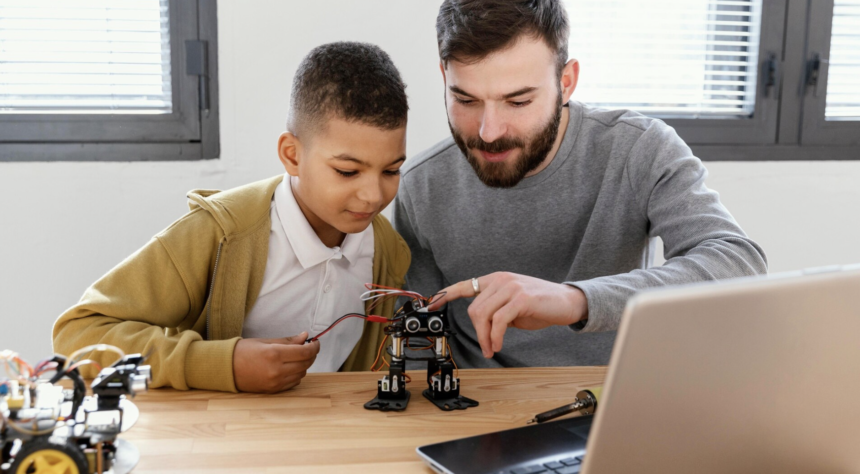
The Bee-Bot robot can be a clear starting point for children who are learning about algorithms and sequence of actions. In contrast to other robotics sets, which are more complex, this form allows the student to focus on the problem itself because they execute commands and see results immediately. Thanks to this, programming is perceived not as an abstract topic, but as an active game with a clear goal.
Bee-Bot robot in the development of spatial orientation
For younger students, it is important to understand the concepts of “left”, “right”, “forward”, and “back”, as well as to correlate movement with the positions of objects on a plane. The Bee-Bot robot helps consolidate these skills through tasks on mats, cards, or marked surfaces.
The teacher can create a route using a grid, with each cell representing a specific item or concept. These can be letters, numbers, images of animals, road signs, or objects from a specific topic. The child is tasked with reaching the desired cell, selecting commands, and checking whether she has composed the sequence correctly.
Such exercises are useful not only for programming. They support the development of attentiveness, the ability to estimate distance, and the ability to mentally predict the result of the action. If the robot has not reached the desired point, the student can analyze the route and correct the commands.
Bee-Bot robot in thematic lessons in primary school
Bee-Bot robot can be included in language, mathematics, natural science, and even reading lessons. To do this, it is enough to adapt the field for movement to the lesson’s topic. For example, on a mathematical mat, the robot moves to the correct answer to the example, and on a language mat, to the word that corresponds to the image.
During natural science classes, students can program a route to cards with animals, plants, or weather phenomena. The teacher asks a question, and the child must find the answer on the grid and plan the correct route. This combines repetition of the material with motor activity and the development of logic.
This format is especially convenient for short station tasks. While one group is working with the robot, the others can do exercises on the cards, read the text, or prepare answers. Then the groups change, and all students have the opportunity to try their hand at working with the device.
Beebot robot for developing sequential thinking skills
One of the main skills that the Beebot robot develops is an understanding of sequence. To achieve the goal, the child must not just press a few buttons, but think about what will happen after each command. This forms the basis of algorithmic thinking.
The teacher can start with simple routes for two or three commands. Over time, the task can be complicated: add obstacles, limit the number of available commands, or ask students to find the shortest path. This way, children gradually learn to compare different options and choose a more effective solution.
The format of work in pairs is also useful. One student name the route, while the other enters the commands; then they check the result together. If an error occurs, the children discuss at what stage the wrong decision was made. This develops the ability to explain one’s own opinion and listen to a partner.
Bee-Bot robot in educational games and quests
Educational quests help make the repetition of the material more dynamic. Bee Bot robot can move between stations where students complete short tasks: solve an example, name a word, find a pair, identify an extra object, or answer a question.
For example, a teacher can create a quest “Journey on a Class Map.” A task is placed on each cell, and the team must lay a route to the finish line. To move on, students must correctly complete the exercise and explain why they chose this particular path.
Ideas for quests with a robot:
- Finding the correct answers on a mathematics grid.
- Route according to the plot of a read fairy tale.
- Game for identifying sounds or letters.
- Traveling with a card with natural zones.
- Task for sorting objects by features.
- Team route with several checkpoints.
Such activities help maintain interest in the topic because the child not only answers but also manages the process. At the same time, the teacher can observe how students plan actions, cooperate, and react to mistakes.
Bee-Bot robot as a support for communication in the classroom
Working with an educational robot Bee-Bot often requires discussion. Before starting, children agree on which direction to move, how many commands to enter, and how to check the result. This creates a natural situation for the development of speech and cooperation skills.
The teacher can propose roles in the team, such as the first student reads the assignment, the second plans the route, the third enters the commands, and the fourth checks whether the robot has reached the required cell. Upon the completion of the assignment, the roles change. Such an approach will help avoid the situation in which one child constantly works with the robot.
The Bee-Bot can also be used for oral language practice. The children can explain the path in complete sentences, give directions, and explain why. In language lessons, this method can be used to review prepositions, movement verbs, and related concepts.
Beebot robot in preparation for more complex technologies
The first lessons in robotics should be understandable and accessible. Beebot robot allows children to learn the basic principles without having to work with complex code. They learn to see the connection between the command and the result, plan the sequence, and correct mistakes.
In the future, these skills can become the basis for working with other educational technologies, block programming, digital models, and more complex robots. Students who already have experience building routes and testing algorithms can more easily move on to new tools.
Inventive Classroom offers solutions for STEM education and modern audiovisual technologies. Such educational products can help schools create a hands-on environment in which children develop skills important for learning in the 21st century.