



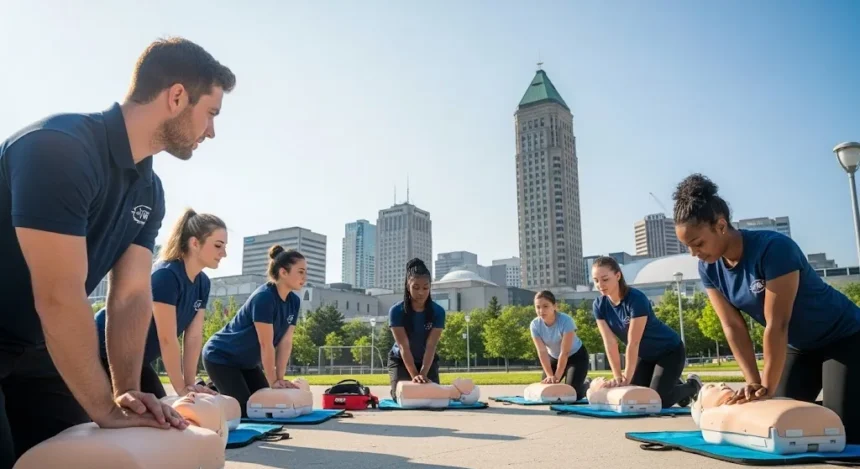
Medical emergencies don’t follow a schedule. They happen at home, at work, at community events, and on university campuses. And in most cases, the difference between a life-changing outcome and a tragic one comes down to a single question: was there someone nearby who knew what to do?
In Oshawa, Ontario, more people are recognising that first aid certification is not just for healthcare workers or safety officers. It’s a practical life skill for anyone who lives or works around other people — which is most of us. Whether you’re a student at Ontario Tech University, an employer with staff on site, a parent, or a community volunteer, there has never been a better time to book Coast2Coast first aid training in Oshawa and build that skill set once and for all.
What Does a Standard First Aid and CPR Course Cover?
This is the question most people want answered before they commit. A Standard First Aid and CPR/AED Level C course is designed for the general public — no medical background required, no prior knowledge assumed.
Here’s what’s included:
CPR for adults, children, and infants. Correct technique matters. Compression depth, rate, and the balance with rescue breaths all affect survival outcomes. The course covers each age group with hands-on practice so the technique becomes instinctive rather than theoretical.
AED operation. Automated external defibrillators are now widely available in public buildings, shopping centres, universities, and workplaces across Ontario. They deliver step-by-step voice instructions, but practising with the device before a real emergency dramatically improves how quickly and correctly it gets used under pressure.
Choking response. For adults, children, and infants — using the appropriate technique for each. A common emergency that causes disproportionate harm simply because bystanders freeze.
Wound management and bleeding control. Applying pressure correctly, recognising arterial bleeding, improvising dressings, and monitoring a casualty while waiting for emergency services.
Fractures and spinal injuries. When to move a casualty and when not to — a decision that can prevent lifelong disability.
Shock, stroke, sudden illness, and allergic reactions. Recognising the signs and initiating the right response for each.
Scene safety and casualty assessment. The first thing a first aider does is make sure they don’t become a second casualty. Understanding how to assess a scene before acting is a foundational skill the course builds from the start.
Why Does It Matter — Especially in Oshawa?
According to the Heart & Stroke Foundation, approximately 40,000 cardiac arrests occur outside of hospital settings in Canada each year. Survival rates decrease by roughly 10% for every minute that passes without CPR. Even in a well-serviced community like Oshawa, where the Durham Regional Police and emergency services maintain strong response times, several minutes will typically pass before paramedics reach a patient.
During that window, what happens depends entirely on who is present and whether they are trained.
Oshawa’s population includes a large student community at Ontario Tech University and Durham College, active manufacturing and logistics sectors covered by Ontario’s Occupational Health and Safety Act, and a growing suburban population with families, recreation facilities, and community organisations. All of these settings — campuses, shop floors, sports fields, community halls — are places where emergencies happen and where a trained person changes the outcome.
Under Ontario’s OHSA framework, employers are required to maintain appropriate first aid coverage for their workforce. WSIB guidelines set the specific requirements based on workforce size and industry type. For many Oshawa businesses, ensuring staff hold current Standard First Aid certification is a compliance requirement as well as a sound workplace practice.
How Long Does It Take to Get Certified?
Less time than most people expect. A Standard First Aid and CPR/AED Level C course is typically completed in a single day. Blended learning formats — where the theory component is completed online in advance — reduce the in-person session to a matter of hours, without any reduction in the standard of training or the credential received.
Standard First Aid certification is valid for three years in Ontario. CPR/AED certification requires annual renewal, though renewal courses are considerably shorter than the initial course. Most individuals and employers build renewal into an annual calendar so coverage never lapses.
What Makes Blended Learning Work?
Traditional first aid training required participants to spend a full day in a classroom. Blended learning splits the experience: the theoretical knowledge component is delivered online, at the participant’s own pace, before the in-person session. The face-to-face time is used entirely for hands-on skill practice — compressions on manikins, AED pad placement, wound care techniques — with a certified instructor providing direct feedback.
For students fitting training around a lecture schedule, employees completing certification during a shift change window, or parents working around school pickups, blended learning removes the biggest barrier most people cite: time.
C2C First Aid & Aquatics offers this format across its Ontario locations, with flexible session times designed around how people actually live and work.
Who Should Get Certified?
The honest answer is: most people. But certain groups have a particularly clear reason to prioritise it.
Students at Ontario Tech or Durham College, especially those entering healthcare, education, or social services programs, will often need CPR certification as a prerequisite for placement. Employers in manufacturing, logistics, and service industries with staff onsite are required to maintain coverage under the OHSA. Coaches, recreation staff, and community volunteers working with children or vulnerable populations carry an informal but very real duty of care. And parents who want to be prepared for the situations that arise in family life — a toddler choking, an elderly parent collapsing, a neighbour having a cardiac event at a community event — have a straightforward and completely personal reason to get certified.
If you are looking for first aid or CPR training near Simcoe Street South, the King Street corridor, or communities around Durham College and Ontario Tech University in Oshawa, you may reach out to Coast2Coast First Aid & Aquatics in that area.
FAQS
Q: Is first aid certification mandatory for Ontario employers in Oshawa? A: Under Ontario’s Occupational Health and Safety Act, employers are required to ensure that first aid services — including trained first aiders — are available for workers during all working hours. The specific requirements depend on the number of workers on-site and the nature of the work. WSIB guidelines set out the minimum standards. For most Oshawa workplaces in manufacturing, logistics, and services, at least one trained first aider per shift is required.
Q: How long is Standard First Aid certification valid in Ontario? A: Standard First Aid certification is valid for three years. CPR/AED Level C certification requires annual renewal. Employers and individuals who maintain a certification register and schedule renewals proactively ensure there are never gaps in coverage.
Q: Is the CPR/AED course the same as Standard First Aid? A: No — CPR/AED Level C is a standalone certification focused specifically on cardiac arrest response, AED use, and choking. Standard First Aid is a more comprehensive certification that includes CPR/AED Level C content alongside wound management, fractures, shock, allergic reactions, and a broader range of emergency scenarios. Standard First Aid is the more complete option for most individuals and workplace compliance purposes.
Q: Can I take the theory component of the course online? A: Yes. Blended learning courses allow the theoretical knowledge component to be completed entirely online at your own pace. You then attend a shorter in-person session for hands-on skill practice with a certified instructor. The resulting certification is equivalent to a traditional full-day course and is recognised for WSIB and Ontario OHSA compliance purposes.
Q: Is first aid training in Oshawa available on weekends? A: Scheduling options vary by provider, but many blended learning providers offer both weekday and weekend in-person sessions to accommodate different schedules. Checking directly with the provider for current availability is the most reliable approach.