



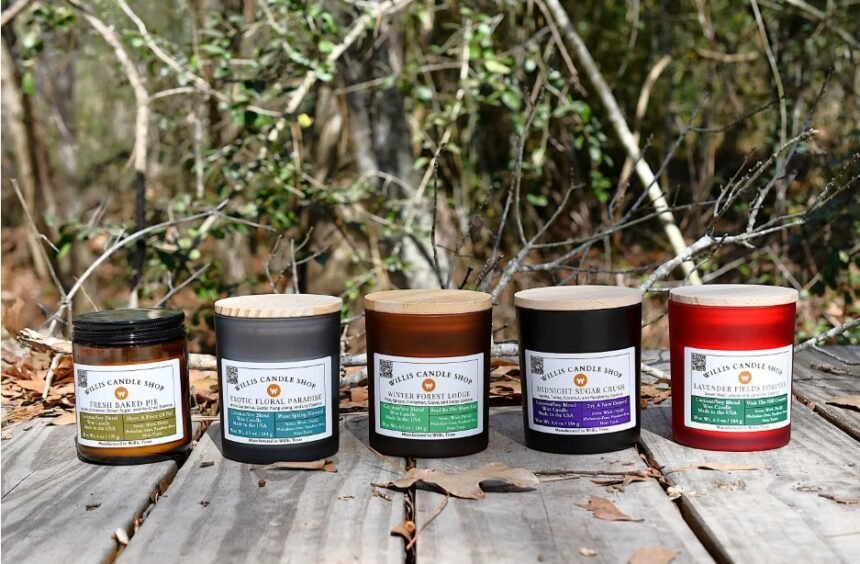
We curate our homes with an obsessive eye for detail. We select textiles for their touch, lighting for its warmth, and furniture for its form, all in service of creating a sanctuary that mirrors our personal values. Yet, there is a fundamental pillar of this invisible architecture that is frequently overlooked: the air we breathe. In the modern pursuit of luxury living, we have become increasingly attuned to the toxins in our food and the chemicals in our skincare, but we often treat the products we burn in our living spaces—our candles—as benign décor. The reality, however, is that every flame initiated is a chemical reaction that fundamentally alters our immediate ecosystem, notes Keyrenter Jacksonville solutions.
The home fragrance industry, often relegated to the background of lifestyle curation, is undergoing a necessary evolution. We are seeing a distinct divide in the marketplace: the industrial giants relying on antiquated petroleum models, the natural-at-all-costs artisans who frequently overlook the thermodynamics of combustion, and the new guard of engineering-led studios. For the discerning individual seeking to align their living environment with high standards of safety and sustainability, the
Willis Candle Shop serves as a vital benchmark. It offers a blueprint for what transparency looks like in an industry historically defined by mystery, proving that we no longer need to compromise between aesthetic indulgence and respiratory wellness.
The Commodity Trap: The Paraffin Reality
For decades, the candle industry has been dominated by the ghost of the petroleum age. Paraffin wax, the industry standard for mass-market goods, is not a luxury material; it is a refined byproduct of the crude oil refining process. It is the viscous residue left behind in the refining barrel, bleached, deodorized, and chemically treated into a slab of wax that is then poured into millions of jars. From an economic perspective, this model is a masterclass in efficiency, but it is deeply problematic from a wellness perspective.
To achieve the “perfect” candle that consumers have been trained to expect—a product that remains flawlessly smooth, maintains its shape in a hot environment, and boasts an aggressive scent throw—manufacturers rely on a complex cocktail of additives. Chemical polymers like Vybar, stearic acid, and microcrystalline wax are essential ingredients in the formulation. These additives are the industry’s version of “aesthetic insurance.” When burned, these candles facilitate the low-level combustion of petroleum byproducts, emitting benzene and toluene in spaces where we sleep, dine, and live. It is an industrial shortcut that favors the shelf-life aesthetic over the long-term respiratory health of the homeowner. For those who curate their homes with care, this is a trade-off that is increasingly difficult to justify.
The Thermodynamic Fallacy of “Natural”
The second tier of the industry—the “misunderstood” category—is centered around the organic essential oil movement. This segment operates on a compelling but scientifically flawed narrative: if a substance is natural, it is inherently the gold standard for wellness. It is a powerful, emotional pitch that resonates with consumers who are rightfully seeking to move away from the industrial hazards of the petroleum paraffin industry. However, this tier often fails to account for the thermodynamics of combustion.
The error here is rooted in the assumption that if an essential oil is safe for topical use—such as in a lotion or a soap—it is safe when burned. The chemistry of the skin is temperate; the chemistry of a candle flame is extreme. When an essential oil is subjected to the intense, concentrated heat of a wick, which can reach temperatures averaging 2,500 degrees Fahrenheit, it is no longer a therapeutic oil. It is a volatile organic compound (VOC) undergoing rapid thermal degradation. Under these extreme conditions, the essential oils break down into acrid compounds that are, in many cases, far less “purifying” than the marketing suggests. Being natural does not inherently mean being thermally stable. We must stop viewing “nature” as an inherently safe shield against scientific scrutiny and instead prioritize substances that are engineered to remain stable when confronted with a flame.
Precision as a Lifestyle Standard
The third branch, the “good,” is where precision meets purpose. This is where high-end, transparent studios operate with a commitment to material science that few others in the industry are willing to undertake. These studios approach the candle not as a casual craft project, but as a piece of functional home equipment that requires rigorous testing, batch control, and R&D. By adopting a transparent, data-driven approach, these studios avoid the traps of both the commodity paraffin market and the unstable “natural” market.
For those interested in exploring a modern approach to the home environment, the eco-friendly candle collection offered by these engineering-focused studios is the first step toward reclaiming indoor air quality. These products are typically built on a verified wax matrix—a specific, engineered blend of soy, coconut wax, and small amounts of beeswax. This blend is specifically designed for a slow, clean, and complete burn, devoid of the chemical polymers used by the paraffin industry to force visual perfection.
This commitment to transparency acts as a “duty of care” to the consumer, ensuring that the experience is consistent, safe, and deeply satisfying. These studios understand that their label does not just tell the consumer what is inside the candle; it also tells them what is not inside the candle, which is often the more important metric in an era of skepticism. They demonstrate that quality is not an accident—it is a result of consistent, disciplined manufacturing processes.
The Future of the Hearth
The final component of this olfactory architecture is the realization that indoor wellness is a continuous process of curation. In the same way that we research the sustainability of our fashion or the nutritional profile of our food, we must apply the same due diligence to the items we introduce into our environment. By choosing products that are engineered for stability, cleanliness, and long-term performance, we commit to a standard of excellence that reflects our values.
The future belongs to brands built on honesty, technical rigor, and a willingness to educate the consumer. We should view our home fragrance choices not just as décor, but as the foundation of the home’s invisible architecture—a testament to a higher standard of living that refuses to compromise on health, safety, or the simple joy of a perfectly clean flame.