Introduction and Market Relevance
Across Canadian infrastructure sites, overgrown vegetation on slopes, ditches, and embankments creates safety hazards and drainage problems. Standard mowers cannot access steep angles safely. A flail mower brush cutter attaches to excavators and backhoes to clear vegetation on challenging terrain. Canadian transportation departments, utility companies, and construction firms use these attachments for roadside maintenance, pipeline corridors, and stormwater pond banks.
Manual clearing of slopes with hand tools is slow, expensive, and exposes workers to fall risks. Excavator-mounted mowers eliminate the need for personnel to work on steep banks, improving safety while reducing labor costs.
Common Applications and Cutting Methods
Flail mower brush cutters are commonly used for:
- Roadside ditch vegetation control
- Stormwater pond bank maintenance
- Pipeline corridor clearing
- Airport perimeter slope mowing
- Railway embankment vegetation management
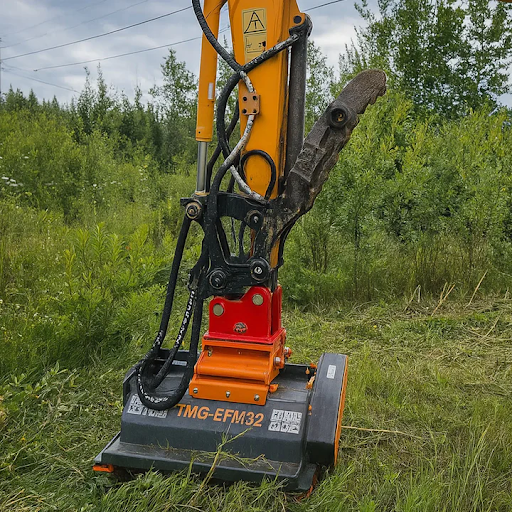
The attachment connects to the excavator’s hydraulic system. Multiple steel flails rotate on a horizontal drum, slicing through grass, brush, and small trees. Flails retract upon striking hard objects, reducing damage risk. The mower head can tilt to match slope angles. Operator controls the cutting height from inside the cab using hydraulic adjustments.
Safety and Operator Protection
Excavator-mounted mowing eliminates the need for personnel to work on steep slopes. The operator remains in the cab on stable ground while the mower head reaches over the edge. This separation reduces fall risk and exposure to thrown debris.
Flail design contains debris within the cutting housing better than blade-type mowers. This reduces projectile risk near roads, buildings, and other infrastructure. The enclosed design also prevents flung material from striking the excavator cab. For roadside work where passing traffic is present, debris containment is a critical safety feature.
Technical Principles and Operational Considerations
The flail mower operates using hydraulic flow from the excavator to spin the rotor. Flails are Y-shaped blades mounted on pivoting attachments. Centrifugal force holds them outward during rotation, but they can fold back when striking rocks or stumps.
Several factors affect cutting performance:
- Hydraulic flow rate from the host machine
- Vegetation height and density
- Ground speed during cutting passes
- Flail sharpness and wear condition
- Slope angle of the working surface
Proper flail maintenance is essential for cutting quality. Dull flails tear vegetation rather than cutting cleanly, leaving ragged edges that heal slowly. Worn flails also increase fuel consumption and slow work progress.
Safety Guidelines and Maintenance Practices
Safe operation of a flail mower requires several key practices:
- Clear area of rocks and wire before mowing
- Keep bystanders 150 feet away
- Stop rotor before clearing jams
- Lower mower to ground before dismounting
- Wear hearing protection in cab
Maintenance includes inspecting flails for wear before each use, replacing bent or worn flails immediately, checking hydraulic hoses for abrasion weekly, tightening belt tension monthly, and cleaning debris from rotor housing after wet conditions. Flails that show visible rounding should be replaced to maintain cutting efficiency.
Advantages and Limitations
Advantages of flail mower brush cutters include:
- Reaches slopes beyond wheeled mower access
- Contains debris better than blade mowers
- Operator remains on stable ground
- Flails retract upon rock impact
- Mulches vegetation into fine debris
Limitations to consider:
- Requires excavator with hydraulic flow
- Not for heavy brush over 2 inches diameter
- Wet grass wraps around rotor shaft
- Rocky ground accelerates flail wear
- Higher cost than standard mowers
Real-World Application Example
A Canadian railway company in British Columbia maintained 50 kilometers of trackside ditches. Vegetation overgrowth blocked drainage, causing washouts during spring melt. Standard rotary mowers could not access 45-degree ditch banks. Hand crews cost 5,000 dollars per kilometer annually. The company purchased an excavator-mounted flail mower for their 3.5-ton excavator. The operator cut both ditch banks while traveling on level right-of-way. The company reduced ditch maintenance cost to 1,200 dollars per kilometer, saving 190,000 dollars annually.
Conclusion and Future Outlook
TMG Industrial Flail mower brush cutters enable excavator owners to perform vegetation management on terrain inaccessible to conventional mowers. The combination of reach, slope capability, and debris containment makes these attachments essential for infrastructure maintenance. As Canadian right-of-way clearing standards become more stringent, demand for specialized slope mowing equipment will likely increase. Future designs may include remote camera systems for operator visibility and laser slope sensors for automatic cutting angle adjustment.
Infrastructure managers responsible for roadside and embankment maintenance should evaluate flail mowers for any site with slopes exceeding 30 degrees requiring regular vegetation control.