


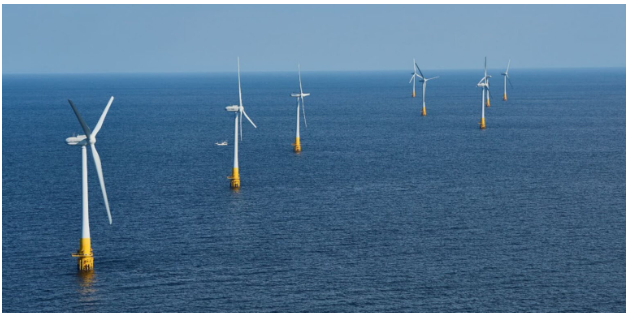
Europe has a floating wind problem, and it’s not the technology. The turbines work. The platforms work. WindFloat Atlantic ran for five years without a major incident. Hywind Tampen feeds power to oil platforms in the Norwegian Sea. What doesn’t work yet is the industrial system behind commercial-scale deployment: the ports, the quays, the vessels, and the fabrication yards.
If you’ve spent time at floating wind events in the past two years, you’ve heard the same word come up: industrialisation. Everyone wants it. Few can explain how to get there before 2030. The reason comes down to one physical constraint nobody can talk their way out of – port capacity.
What Floating Wind Actually Needs From a Port
Fixed-bottom offshore wind is not easy to install, but ports understand it now. Monopile components are large, but they’re cylindrical and stack predictably. Floating platforms are a different problem.
A semi-submersible hull for a 15 MW turbine needs fabrication space measured in hectares, not square metres. The completed structure, before the turbine goes on top, can weigh several thousand tonnes. It floats out to sea under tow, which sounds convenient until you realise that means the entire assembly must happen dockside with direct sea access. You can’t truck a semi-sub down the road. You can’t offload it at an inland facility and barge it later. It has to go together at the water’s edge.
Few ports in Europe meet this spec today. BrestPort in France is perhaps the best-known case in progress: its offshore renewable energy terminal upgrade is designed for large floating structures and has become a reference point at floating wind Europe discussions. But Brest is one port. Scotland’s Celtic Sea ambition, Norway’s Utsira Nord pipeline, and Italy’s Mediterranean projects all need the same thing at roughly the same time.
As documentation from the Floating Offshore Wind 2026 conference noted, floating wind projects need sizeable fabrication areas, specialised lifting equipment, and long staging windows. Most ports can meet one or two of those requirements. Almost none can meet all three.
The Vessel Shortage Hiding Behind the Port Problem
Port capacity is the constraint most people see. The vessel shortage is the one hiding behind it.
The EIC’s UK and Europe offshore wind report, published in August 2025, put a number on it: of roughly 80 specialist installation vessels operating across Europe, only five can handle turbines in the 14-15 MW class. Five. For a continent planning to build tens of gigawatts of floating wind before 2035.
Floating platforms can be towed to site rather than lifted by a jack-up vessel, which helps. But the heavy-lift vessels required for turbine installation on a floating hull in open water don’t exist in the quantities Europe needs. Global demand for installation vessels is projected to grow fivefold by 2030, with European developers competing for the same assets as projects in South Korea, Taiwan, and Japan.
Ordering a new specialist vessel takes three to five years and costs several hundred million euros. The yards that build them are already backlogged. Anyone expecting the market to self-correct by 2029 is reading a different order book.
The Timeline Problem Nobody Wants to Calculate
Here’s the number that should be in every presentation at offshore wind forums but rarely is: port expansions take six to ten years from permit to operation.
The EIC report flagged this directly. If a port started the permitting process for a floating wind terminal today, in mid-2026, the most optimistic completion date would be 2032. The realistic date would be 2034 or later.
Europe’s 2030 floating wind ambitions don’t fit that maths. The Celtic Sea round awarded leases in 2025. Commercial-scale projects from those leases won’t reach financial close before 2027 at the earliest. Construction would start around 2028-2029. That gives ports roughly two to three years to be ready. They need six to ten.
GWEC’s analysis was direct: bottlenecks in floating offshore wind foundations are projected to emerge from 2029 onwards, right when Europe’s first commercial-scale projects need them not to exist.
The Installation Lull Makes It Worse
Wood Mackenzie’s December 2025 supply chain analysis added another layer. Tender delays and cancelled offtake agreements are creating an installation lull between 2027 and 2030. That gap will hurt suppliers at exactly the wrong moment: when they should be investing in expanded capacity to serve the post-2030 surge, they’ll be managing thin margins and reduced cash flow instead.
A supply chain that can’t fund investment during a lull won’t be ready when demand returns. The offshore wind sector lived through this dynamic in 2022-2024, when cost inflation forced project cancellations and damaged relationships between developers and manufacturers. Floating wind is young enough that it cannot afford a repeat of that cycle.
The irony is painful: Europe needs the supply chain to invest now, during a period of uncertainty, to serve projects that won’t need those investments for another four to six years. That’s not how suppliers allocate capital. It’s how public infrastructure programmes work.
What the Industry Is Actually Doing
Cross-port alliances are one practical response. The logic is straightforward: no single port can handle everything, so coordinating across ports reduces fragmentation and helps developers plan logistics across a system rather than betting everything on one facility. Brest, Bilbao, and several Scottish ports have been involved in conversations along these lines, with floating wind Europe events providing the forum for those discussions to move from principle to specifics.
The UK’s Crown Estate built grid coordination into the Celtic Sea leasing process from the start, which is at least a sign that some infrastructure bottlenecks are being handled earlier in the development cycle. Norway’s Utsira Nord tender came with a NOK 35 billion subsidy cap specifically designed to keep costs at commercial scale low enough to attract serious bids.
France’s approach at AO5 and AO6 created signals for supply chain localisation in both the Atlantic and Mediterranean. Whether those signals translate into fabrication yards and port investment before 2030 is the genuine question. Signals are not warehouses.
What Floating Wind Events Are Telling Us
Track the floating wind Europe conference agenda over the past 18 months, and a shift is visible. In 2023, panels spent most of their time on platform technology and mooring systems. By 2025 and into 2026, port logistics and supply chain industrialisation dominate the programme. That’s progress in one sense: the industry has moved past debating whether the technology works to debating how to build it at scale.
But the agenda shift also reflects growing awareness that physical constraints are real and cannot be solved by smarter policy alone. Port quays don’t grow because a regulator passes a law. Heavy-lift vessels don’t materialise because a developer’s timeline requires them.
What’s useful about offshore wind events is that they force the people who control different parts of the system into the same room. Port operators, vessel owners, turbine manufacturers, and developers rarely sit around the same table in their normal working lives. Conferences are often where those relationships start, and in a sector where long-term commitments across the supply chain are the entire problem, those relationships matter.
The Honest Assessment
Europe will not have the floating wind port infrastructure it needs by 2030. That is not a pessimistic reading. It is arithmetic.
What Europe can do is make sure the infrastructure that comes online in 2030-2032 serves a pipeline that has been designed around what ports can actually handle. That means developers making long-term port commitments now rather than treating port selection as a late-stage logistics problem. It means governments fast-tracking port permitting with the same urgency they’ve applied to energy permitting generally. And it means the offshore wind industry using floating wind events and cross-sector forums to build coordination the market alone won’t produce.
Floating wind’s technology risk was largely resolved by the end of 2024. The decade between Hywind Scotland’s 2017 commissioning and today answered the core engineering questions. The question for the rest of this decade is whether Europe can build the industrial system fast enough to matter.
The turbines are ready. The ports are not. That gap needs to close before 2030 becomes a target Europe retrofits an excuse onto rather than a deadline it actually meets.