



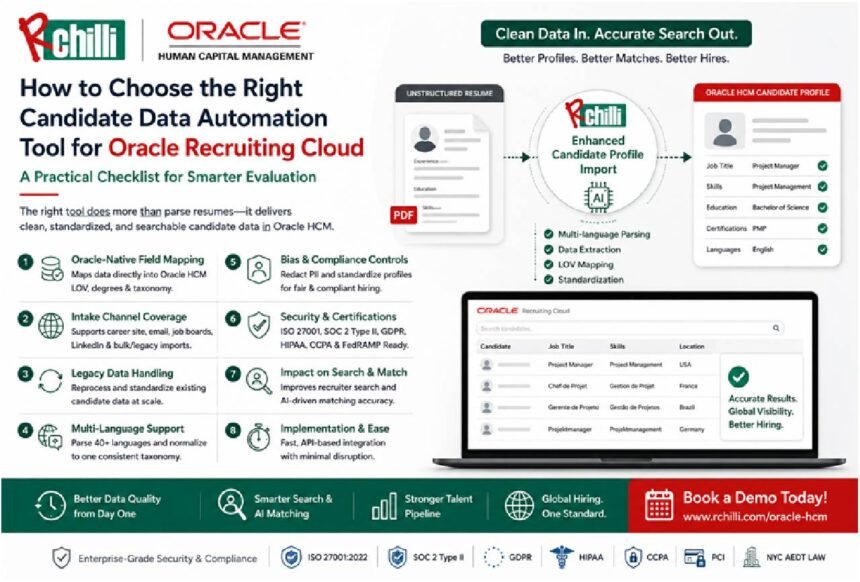
The right candidate data automation tool for Oracle HCM does more than convert a resume into text. It has to map that data into Oracle’s specific field structure, handle the languages and formats your candidates actually use, and keep working after the initial rollout as your candidate database grows and drifts. Evaluate against those requirements directly, rather than against a generic “resume parsing” feature list that doesn’t account for how Oracle Recruiting Cloud actually structures candidate data.
Start With Oracle-Native Field Mapping, Not Generic Extraction
Generic resume parsers extract data into their own format and leave you to manually map fields to Oracle. That’s extra engineering work upfront and an ongoing source of inconsistency every time the underlying taxonomy changes or a new field gets added to your Oracle configuration. The tools worth evaluating map extracted data directly into Oracle’s List of Values (LOV) fields, degree structures, and taxonomy from the start, without requiring your team to build and maintain a separate translation layer.
Ask any vendor directly: does this map into Oracle HCM’s controlled picklists natively, or does my team need to build and maintain that mapping layer separately? The answer to this single question often predicts more about long-term implementation cost than any other criterion on this list. List of Values (LOV) is built specifically to answer this, standardizing parsed values like job titles and degrees against Oracle’s own picklists rather than a generic taxonomy that needs translation afterward.
Evaluation Criteria That Actually Predict Success
- Field coverage and structure. Does it extract beyond basic contact details, into work history, education, certifications, and skills, structured in a way Oracle can use natively rather than as unstructured text dumped into a notes field? Shallow extraction that only captures name and contact information looks similar to full extraction in a demo, but the gap becomes obvious the first time a recruiter tries to search on skills or certifications. See Enhanced Candidate Profile Import for what full-coverage extraction looks like inside Oracle HCM specifically.
- Intake channel coverage. Resumes arrive from career sites, email, LinkedIn, job boards, and legacy system migrations, not from a single controlled source. A tool that only handles the career site upload creates gaps everywhere else candidates and recruiters actually bring resumes into the system. This matters more than it initially appears, since a tool that solves 80 percent of intake but leaves email and job board sourcing manual just relocates the original data entry problem rather than solving it. RChilli’s Recruiter Hub covers this with Browser Assistant for job board sourcing, Email Importer for inbox intake, and Bulk Data Import for high-volume or legacy migration.
- Legacy data handling. New candidate intake is only half the problem if your existing Oracle tenant already contains years of inconsistent records built before any standardization tool was in place. Ask specifically whether the tool can reprocess historical records, and on what schedule. A tool that only improves new applicants leaves the majority of an established Oracle tenant’s candidate database permanently out of date. Full Database Reprocessing reprocesses historical profiles against current parsing and taxonomy rules on a schedule you control, rather than leaving legacy data permanently frozen at whatever quality it had when it was first entered.
- Multi-language support. If you hire globally, confirm the tool parses and standardizes resumes across the languages your candidates actually apply in, and maps them to one consistent taxonomy rather than leaving titles and skills in their original language, invisible to searches run in a different language. Enhanced Candidate Profile Import covers this across 40+ languages, with normalization handled by List of Values (LOV) and Customizable Taxonomy so language of origin doesn’t determine whether a candidate is searchable.
- Bias and compliance controls. For organizations running blind or structured screening, check whether the tool supports redacting identifying details before hiring managers see a profile, and whether that redaction is configurable to specific job families or hiring stages rather than all-or-nothing. Redact & Design removes fields like name, gender, and nationality and presents candidates in a standardized template for fairer evaluation, which also gives HR and legal teams concrete process evidence during DE&I reviews.
- Security and compliance certifications. Confirm the vendor holds relevant certifications for enterprise deployment: ISO 27001, SOC 2 Type II, GDPR, HIPAA, CCPA, and FedRAMP readiness are the baseline for handling candidate PII at scale. This isn’t a checkbox exercise. Candidate resumes contain some of the most sensitive personal data an HR system handles, and a vendor’s certification posture should be verifiable, not just asserted in sales materials.
- Downstream search and match impact. The point of clean intake isn’t just tidy records, it’s that recruiter search and AI-driven matching actually work once the data is in the system. A tool can technically parse resumes correctly and still fail this test if the standardized output doesn’t actually improve what recruiters can find and filter on day to day. See AI Agents for Oracle Fusion Applications for what structured, standardized candidate data enables once it’s built on a clean Enhanced Candidate Profile Import foundation.
- Implementation timeline and disruption to existing workflows. A tool that requires re-architecting your existing Oracle configuration carries hidden costs well beyond the vendor’s license fee. Ask specifically how long initial connectivity takes and whether it requires changes to your current Oracle setup, or works as an addition on top of it without disrupting existing requisition and approval workflows.
Putting the Checklist to Use
Run each vendor you’re evaluating through all eight criteria before comparing pricing. It’s common for a tool to score well on field coverage and extraction accuracy in a demo, while failing criteria three and four, legacy data handling and multi-language support, that only become obvious once you’re already mid-implementation. Evaluating the full list upfront avoids discovering those gaps after a contract is signed.
A Note on Comparing Specific Vendors
This checklist is meant to be used before you get into named vendor comparisons. Once you’ve narrowed the field, the full RChilli Oracle HCM solution suite lays out how each capability, from intake to data hygiene to bias controls, fits together in one Oracle-native deployment, rather than as separate point solutions that need to be integrated by your own team.
FAQ
What’s the difference between generic resume parsing and Oracle-specific candidate data automation? Generic parsers extract data into their own format and require manual mapping to Oracle’s fields afterward. Oracle-specific tools map extracted data directly into Oracle’s LOV structure, degree taxonomy, and picklists from the start, removing that translation work.
Should legacy candidate data be part of the evaluation? Yes. A tool that only handles new resumes leaves years of existing Oracle records under-standardized. Full database reprocessing capability should be part of any evaluation, not treated as a separate, optional add-on.
What certifications should a candidate data automation vendor have? At minimum, ISO 27001, SOC 2 Type II, GDPR, HIPAA, and CCPA compliance, plus FedRAMP readiness for public sector or federal-adjacent hiring. These should be independently verifiable, not just referenced in marketing materials.
How long should implementation take for a well-built Oracle-native tool? Well-built Oracle-specific tools are generally designed for rapid, API-based integration without requiring re-architecture of existing workflows. If a vendor’s timeline estimate involves months of custom development, that’s a signal the tool wasn’t purpose-built for Oracle HCM in the first place.
Is multi-language support worth evaluating even if we currently hire in one country? If there’s any plan to expand hiring internationally, yes. Retrofitting multi-language support and taxonomy normalization onto years of single-language candidate data is significantly more disruptive than building it in from the start.
See how Enhanced Candidate Profile Import meets these criteria inside Oracle HCM, or explore the full RChilli Oracle HCM solution suite to walk through your specific requirements against each capability.