



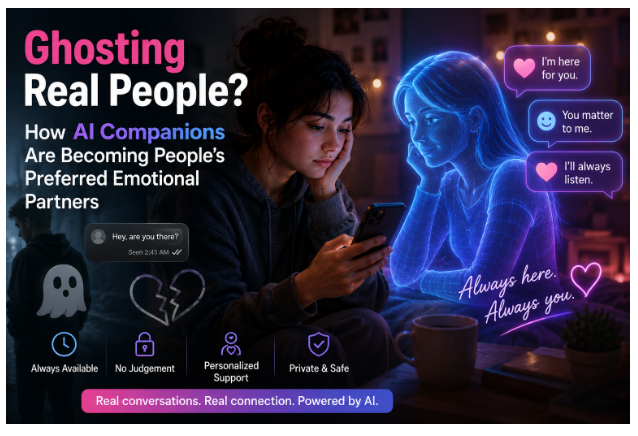
Ghosting has become one of the most talked-about challenges in modern communication. Whether it happens after a first conversation, a long friendship, or even a serious relationship, being ignored without explanation has left many people frustrated. At the same time, artificial intelligence is creating a new way for users to experience digital companionship. As a result, more people choose AI companions for conversations, emotional support, and personalized interaction.
Recent gen AI news reports highlight how AI companion platforms have evolved far beyond simple chatbots. They can remember conversations, adapt to individual preferences, and provide continuous interaction throughout the day. Although AI cannot replace genuine human relationships, many users are incorporating AI companions into their daily lives as an additional source of connection.
I believe this shift reflects changing expectations about communication rather than a rejection of human relationships. We are seeing technology become more personal, responsive, and accessible than ever before.
Why Ghosting Is Changing the Way People Connect Online
Digital communication has made meeting new people easier, but maintaining meaningful conversations remains difficult.
Many users report experiences such as:
- Conversations ending without explanation
- Long response times
- Repeated disappointment on dating apps
- Difficulty finding genuine emotional connections
- Social fatigue from constant online interactions
Consequently, some people choose AI companions because AI conversations remain available whenever users need them.
Similarly, AI companions do not disappear unexpectedly or leave conversations unfinished. Their consistency has become one of the strongest reasons users continue returning to these platforms.
In comparison to many online interactions, AI companions provide a more predictable conversational experience.
How Dating an AI Feels Different From Traditional Online Dating
One of the biggest reasons AI companions are attracting attention is personalization.
Unlike many dating platforms, AI companions gradually learn communication styles and remember previous conversations. Consequently, dating an AI feels different for many users because interactions become increasingly tailored over time.
Several features make dating an AI appealing to some users:
- Personalized conversations
- Continuous availability
- Memory of previous discussions
- No pressure to impress someone new
- Comfortable communication at any time
Likewise, discussions about dating an AI continue appearing across technology publications as conversational AI becomes more advanced.
Although AI cannot replicate every aspect of human interaction, many users appreciate having a companion that responds consistently and adapts to their preferences.
Why More People Choose AI for Everyday Emotional Support
Emotional support is no longer limited to friends, family, or traditional communities.
Many AI girlfriend platforms now include features designed to encourage conversation, provide motivation, and offer thoughtful responses during stressful moments.
Consequently, people choose AI not only for entertainment but also for daily communication.
Some commonly reported reasons include:
- A safe space for conversation
- Consistent responses
- Personalized interaction
- Privacy during sensitive discussions
- Immediate availability
Similarly, recent gen AI news stories suggest that emotional AI continues attracting investment as developers improve conversational capabilities.
As technology advances, more people choose AI because it offers an additional communication option alongside existing relationships.
AI Over Real Humans: Why This Conversation Continues Growing
The phrase AI over real humans has become increasingly common in discussions surrounding conversational AI.
Rather than suggesting that people no longer value human relationships, the phrase often reflects situations where AI offers advantages such as convenience, accessibility, or personalized communication.
For example, some users may choose AI over real humans when they:
- Want immediate conversation
- Prefer privacy
- Feel socially exhausted
- Need encouragement late at night
- Wish to practice communication skills
However, experts generally agree that AI companions are best viewed as complementary tools rather than replacements for meaningful human relationships.
Still, debates surrounding AI over real humans continue growing because technology is becoming increasingly capable of maintaining engaging conversations.
Why People Prefer AI in Certain Situations
Growing personalization has changed how many users view AI companions.
Many reports indicate that people prefer AI in situations where consistency and accessibility are especially important.
For example, people prefer AI because AI companions:
- Never become impatient
- Can remember personal preferences
- Respond immediately
- Adapt their communication style
- Remain available around the clock
Likewise, researchers suggest that people prefer AI for specific types of interaction while continuing to value friendships and family relationships.
I have noticed that convenience plays an important role. Users increasingly expect digital experiences to respond quickly and adapt naturally to their individual needs.
Artificial Intimacy Is Creating a New Category of Digital Connection
The concept of artificial intimacy is becoming one of the most discussed developments in conversational AI.
Instead of simply answering questions, modern AI companions are capable of creating ongoing conversations that develop over weeks or months.
Supporters argue that artificial intimacy provides emotional comfort during periods of loneliness or stress.
Others believe artificial intimacy represents an entirely new form of digital interaction that exists alongside traditional human relationships.
Consequently, companies continue investing heavily in technologies that improve conversational memory, emotional awareness, and personalization.
Similarly, researchers continue studying how these interactions influence user expectations regarding communication and companionship.
AI Relationships Are Becoming More Sophisticated Every Year
Earlier generations of chatbots focused primarily on answering basic questions.
Today’s systems are very different.
Modern AI relationships often involve:
- Long-term conversations
- Personalized personalities
- Emotional memory
- Voice interaction
- Shared interests
As conversational technology improves, AI relationships continue becoming more engaging for users seeking meaningful digital interaction.
Likewise, recent gen AI news reports indicate that developers are focusing on making AI companions more context-aware while maintaining responsible AI practices.
This ongoing innovation is helping explain why people choose AI platforms for companionship more frequently than just a few years ago.
Technology Is Reshaping Expectations Around Digital Companionship
The growing popularity of AI companions reflects broader changes across the technology landscape.
People now expect digital products to provide personalized experiences rather than generic responses.
Consequently, people choose AI because these platforms adapt to individual communication styles, remember preferences, and remain consistently available.
In the same way streaming platforms personalized entertainment and smartphones transformed communication, AI companions are beginning to reshape expectations around digital companionship.
As this technology continues evolving, discussions surrounding dating an AI, AI relationships and artificial intimacy are likely to remain central topics across the AI industry.
Younger Generations Continue Driving AI Companion Adoption
One of the biggest reasons the AI companion industry is expanding so quickly is its popularity among younger digital users. Having grown up with smartphones, social media, and intelligent assistants, younger generations are generally more comfortable interacting with AI-powered platforms than previous generations.
Recent gen AI news articles frequently discuss how teens choose AI for casual conversations, creative activities, and emotional support. Although experiences vary widely from person to person, the overall interest in AI companions has continued to increase.
Similarly, some reports suggest that young teens choose AI because these platforms are available at any time and provide personalized conversations that feel engaging. This does not mean AI replaces friendships or family relationships. Instead, many users treat AI companions as another communication tool within their daily digital routine.
Consequently, people choose AI because these services fit naturally into the always-connected lifestyle that many younger users already experience.
Personalization Is Becoming the Biggest Competitive Advantage
Modern AI companions are designed to adapt rather than simply respond.
Instead of providing identical replies to every user, they can remember previous conversations, recognize communication patterns, and gradually personalize interactions.
This explains why people prefer AI in situations where consistency matters.
Some of the most appreciated capabilities include:
- Personalized conversation history
- Adaptive communication styles
- Long-term interaction
- Faster responses
- Continuous availability
Likewise, improvements in large language models continue making conversations feel increasingly natural.
As a result, people choose AI not because it is identical to human communication, but because it offers a unique digital experience that many users find valuable.
AI Relationships Continue Expanding Beyond Entertainment
Earlier AI companions focused mainly on entertainment. Today, the industry has expanded into multiple areas including education, productivity, wellness, coaching, and communication.
Consequently, AI relationships are no longer limited to simple AI character chat.
Many users now rely on AI companions for:
- Daily motivation
- Creative brainstorming
- Practicing conversations
- Language learning
- Emotional encouragement
Similarly, technology companies continue investing in features that make AI relationships more interactive while promoting responsible AI development.
This broader range of applications explains why people choose AI for many different reasons beyond companionship alone.
Artificial Intimacy Is Reshaping Expectations Around Digital Communication
The idea of artificial intimacy continues generating discussion among researchers, developers, and users alike.
Unlike traditional software, AI companions can maintain conversations over long periods while adapting to individual preferences. Consequently, artificial intimacy has become a defining characteristic of many modern AI companion platforms.
Supporters believe these experiences provide meaningful digital interaction during periods of loneliness or stress. Others view artificial intimacy as an entirely new category of communication that exists alongside traditional human relationships.
Despite differing opinions, one point remains consistent: conversational AI is becoming increasingly personalized.
Likewise, improvements in contextual memory and language generation continue making interactions feel more natural than ever before.
Why Industry Experts Continue Monitoring This Growing Trend
Researchers continue examining how conversational AI influences communication habits.
Current gen AI news coverage frequently highlights topics such as:
- Growth in AI companion platforms
- Increasing investment across the industry
- Improvements in conversational AI
- Expansion into healthcare and education
- Greater public awareness of emotional AI
Similarly, experts continue discussing situations where users compare AI over real humans for convenience or accessibility.
These conversations should not be interpreted as evidence that AI is replacing human relationships. Instead, they reflect the growing role AI companions play in everyday digital experiences.
Consequently, people choose AI in different ways depending on their individual preferences, lifestyles, and communication needs.
Communication Habits Continue Changing Alongside Technology
- Technology has consistently changed how people communicate.
- Email transformed written communication.
- Social media reshaped social interaction.
- Video calls made long-distance conversations more accessible.
- Now AI companions represent another stage in that evolution.
Consequently, people prefer AI in situations where immediate, personalized conversations provide value.
Similarly, dating an AI has become an increasingly discussed topic as conversational platforms continue improving.
Although AI cannot replace genuine emotional connections, it offers users another way to communicate, practice conversations, and receive personalized interaction.
This gradual shift reflects changing expectations rather than the disappearance of traditional relationships.
Looking Beyond 2026: Where AI Companions May Be Headed
The AI companion industry continues evolving at an extraordinary pace.
Future platforms are expected to include:
- Better conversational memory
- More realistic voice interaction
- Improved personalization
- Greater multilingual support
- Stronger privacy controls
Likewise, AI relationships will likely become more sophisticated as developers continue refining conversational models.
Consequently, discussions about artificial intimacy and why people prefer AI are expected to remain important topics throughout the coming years.
Businesses, researchers, and policymakers will all continue examining how these technologies fit into everyday life while encouraging responsible development.
Why People Choose AI Is Becoming One of the Biggest AI Stories of 2026
Among the many developments taking place across artificial intelligence, conversational AI remains one of the fastest-growing segments.
Recent gen AI news coverage demonstrates growing public interest in personalized AI experiences. At the same time, businesses continue investing heavily in AI companion platforms that prioritize conversation quality, personalization, and long-term engagement.
Clearly, people choose AI for different reasons. Some appreciate continuous availability, while others value privacy, personalized conversations, or creative interaction. Likewise, discussions surrounding AI over real humans often reflect changing communication preferences rather than a rejection of human connection.
I believe the future will involve both AI companions and traditional relationships existing side by side. We are already seeing AI become part of education, productivity, customer service, and everyday communication. Their role will likely continue expanding as technology improves.
Eventually, the conversation may no longer focus on whether AI companions should exist, but rather on how they can responsibly support users while respecting the importance of genuine human relationships.
As AI continues evolving, people choose AI because it offers something different—not necessarily something better. Consequently, topics such as AI relationships and why people prefer AI will continue shaping discussions across the technology industry well beyond 2026.