



More Than a Dress Code
Clerical shirts are one of the most recognisable garments in the world, and yet most people, if pressed, couldn’t tell you much about them beyond “black shirt, white collar.” There’s something quietly remarkable about that. A single item of clothing communicates an entire vocation before its wearer has said a word.
I find that fascinating. We live in an age when personal branding is a cottage industry, when people agonise over what their wardrobe says about them, and yet here is a garment that has been doing exactly that work, with perfect efficiency, for centuries. The clerical shirt isn’t just a uniform. It’s a statement of identity, a pastoral tool, and, for many of the men who wear it, a daily act of commitment made visible.
A Brief History of the Collar
Clerical dress has deep roots. Early Christian clergy were distinguished by modest, dignified clothing that set them apart from the general population, though nothing as standardised as what we know today. The Roman collar as a distinct, formalised feature emerged gradually, becoming more widespread through the 19th century as the Church sought greater visual consistency for its clergy in an increasingly modern, sometimes hostile, world.
It wasn’t only Catholics. Anglican clergy, Lutherans, Methodists and other Protestant denominations adopted versions of the collar too, which explains why the sight of a man in clerical dress doesn’t necessarily tell you his precise tradition, only that he’s ordained and means business. The collar crossed denominational lines because it worked. It still does.
The Anatomy of a Clerical Shirt
Collar Styles
Not all clerical collars are created equal, and the differences matter more than you might expect.
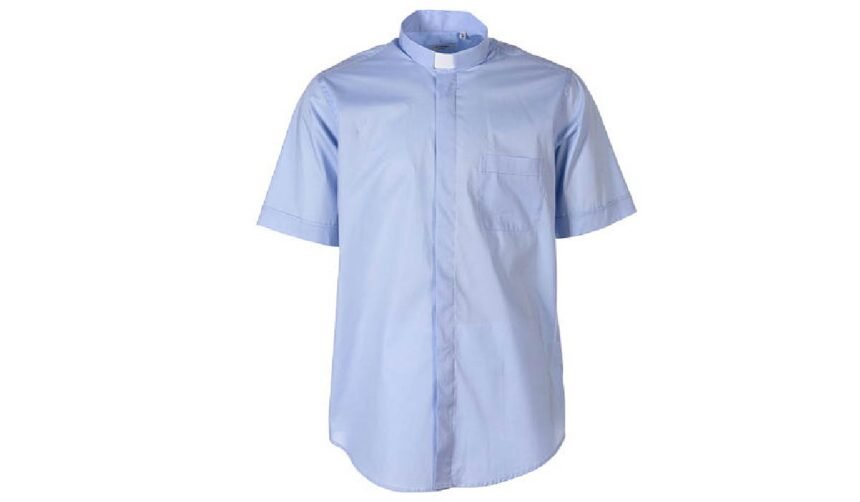
The Roman collar, sometimes called a full collar, is the classic: a stiff white band encircling the neck, often worn with a black shirt. It’s the version most people picture. Then there’s the tab collar, a shirt with a small white insert visible through a narrow opening at the throat, which gives a slightly less formal appearance while still signalling clerical identity clearly. Finally, the band collar (or collarless shirt worn with a separate white insert) is particularly common in warmer climates or less formal contexts.
For many priests, the collar piece itself is detachable, a small white insert that slots into the shirt and can be removed for laundering. It’s one of those practical details that the uninitiated rarely consider, but which any curate who’s wrestled with a damp collar at seven in the morning knows intimately.
Fabric and Fit
The materials used in clerical shirts have evolved considerably. Traditional options leaned toward heavier cotton and polyester blends, prioritising durability over comfort. More recent designs favour lighter, breathable fabrics that hold their shape through a twelve-hour day without making the wearer feel like they’re being slowly upholstered.
Fit, too, matters enormously. A priest’s clerical shirt goes everywhere with him: the hospital ward, the school assembly, the parish council meeting, the graveside. A garment that restricts movement or crumples badly isn’t just uncomfortable, it undermines the quiet dignity the shirt is meant to project.
What the Colours Actually Mean
Black is the default, and has been for so long that it’s easy to forget it was ever a choice. It signals solemnity, humility, and a certain stepping-back from vanity that ordained life invites. It’s also, practically speaking, very forgiving of ink stains and liturgical incense.
Beyond black, other colours carry specific meanings. Grey has become increasingly common as a slightly softer alternative, popular particularly in Anglo-Saxon contexts. Blue is associated with certain religious orders and Marian devotion. White is worn by some clergy in tropical climates, and by the Pope himself. Purple indicates a bishop, and red a cardinal, which is why you should always do a double-take before complaining about the traffic to the man standing next to you in the supermarket queue.
A note worth making: not every person wearing a black shirt and white collar is a Roman Catholic priest. Anglican, Lutheran, and other ordained ministers wear the same style. The collar signals ordination. The tradition it belongs to requires a little more context.
Everyday Wear vs Liturgical Dress
There’s a distinction that often gets lost in popular understanding: clerical shirts are not vestments. Vestments, the chasubles, albs, stoles and so on, are worn during Mass and the sacraments. Clerical shirts are the everyday garment, the one a priest wears to answer the door, visit a parishioner in hospital, sit through a deanery meeting, or pick up bread and milk on the way home.
This matters because it means clerical shirts need to be genuinely functional. They’re worn for long hours, in varied conditions, and washed frequently. The question of when clergy should wear clerical dress in public is debated in some communities, with some preferring to be identifiable at all times and others reserving it for more formal occasions. But for the majority, the shirt is simply part of getting dressed in the morning.
Why It Still Matters in a Secular Age
In an increasingly secular society, visible clerical identity is a more complicated thing than it once was. On one hand, the collar remains a beacon. People who would never walk into a church will approach a priest on the street, sometimes in moments of genuine crisis. The collar signals availability, a willingness to engage, a particular kind of pastoral presence.
On the other hand, visibility has its costs, and clergy are more aware of that than they used to be. There’s a renewed conversation, particularly among younger priests, about reclaiming the collar as a positive symbol, worn with confidence rather than apology. That resurgence of interest in traditional clerical dress among recently ordained men is striking, and not incidental.
Choosing the Right Clerical Shirt
For priests and seminarians navigating this for the first time, a few practical considerations go a long way.
- Collar type — Consider the contexts you’ll most frequently be in. Tab collars tend to suit less formal parish settings; Roman collars carry more weight in formal or public-facing situations.
- Fabric weight — A heavier weave suits cooler climates; lighter fabrics are worth the investment for those in warmer regions or who run warm.
- Sizing — Clerical shirts are worn for long periods, so err toward comfort around the neck and shoulders without going so loose the collar insert sits crookedly.
- Ease of laundering — Easy-care fabrics that don’t require ironing into submission are worth seeking out.
Quality and value do intersect, particularly with manufacturers who specialise in clergy garments and understand the specific demands of daily ministerial life.
Wearing It Well
The clerical shirt, when you step back and think about it, is a remarkable thing. It does in seconds what most communication takes minutes to accomplish. It identifies, reassures, and invites, all without a word. For the men who wear it day in and day out, it becomes as natural as breathing, and as significant.
It isn’t a costume, and it isn’t merely a uniform. It’s a choice renewed every morning, a visible sign of a life given over to something larger than oneself. Clerical shirts carry that weight lightly, which is exactly what good design, and good vocation, should do. Those interested in this distinctive style can explore a dedicated online selection of tailored garments designed for comfort and everyday use, featuring options suited to different preferences.