



A personal account of finding WFH furniture that stopped feeling like office equipment
I want to tell you about a problem I solved recently, though ‘problem’ makes it sound more dramatic than it was. It was more of a persistent low-level dissatisfaction — the kind that you stop consciously registering and start simply living around, until the day something changes and you realise how long you had been accommodating it.
The thing I had been accommodating was a standing desk. Not this one — an earlier one that I bought two years ago when my back started complaining about the kitchen table I had been calling a home office since the spring of 2020. It was a perfectly functional desk. Height-adjustable, stable, motor quiet enough not to alarm the cat. Black frame, white laminate surface, the visual register of a medium-sized corporation’s stationery cupboard. It sat in a room I had spent three years making warm and considered, and it looked like it had been installed by someone who had not looked at the room.
I am not, to be clear, someone who buys furniture on impulse or changes it casually. Every other piece in that room was chosen carefully. The bookcase came from a salvage yard. The chair is mid-century, reupholstered twice. The floor lamp has been in three flats with me. The desk was the only thing in the room that had not been thought about — only decided under the pressure of a back complaint and a next-day delivery option — and every time I closed the laptop and looked up, it reminded me of that.
The Problem I Was Trying to Solve
Let me be precise about what I was looking for, because it is not what most standing desk reviews are written to help you find.
I was not looking for the fastest motor, the widest height range, or the most weight capacity. I was not looking for a desk that would impress a visitor who cared about standing desks. I was looking for a desk that would not be the most distracting object in a room I had spent considerable effort making peaceful. A desk that, when the laptop closed at five-thirty, would stop being a workstation and start being furniture — part of the room rather than an interruption of it.
Every standing desk I researched solved the ergonomic problem and created the aesthetics problem. Brushed aluminium. Black powder-coat. Surfaces that were wood-adjacent — wood-effect laminate, wood-print vinyl — rather than wood. In a room with floorboards worn to a particular honey colour and walls painted the specific off-white that takes three attempts to get right, none of them were going to belong.
What I Was Actually Looking For
The questions I found myself asking while researching were not the questions standing desk review articles are set up to answer. Does the wood surface look warm in morning light, or does it photograph warm and look cold in person? Is the base colour something that will read as furniture in a room with aged timber, or will it read as equipment regardless of the surface above it? When I walk into the room on a Saturday morning when I am not working, does the desk make me feel like I am still in the office, or does it simply belong to the room like everything else in it?
These are not questions with spec-sheet answers. They are questions about whether a product was designed with the domestic room in mind rather than only the corporate office. And the honest answer, for most of the standing desk category, is that it was not.
The motor noise question did have a practical dimension: my study shares a wall with next door’s sitting room. A quiet motor matters not because I am particularly noise-sensitive but because I am noise-conscious — I would rather not be the neighbour whose furniture announces itself through Victorian brickwork at eight in the morning.
Finding the Julia
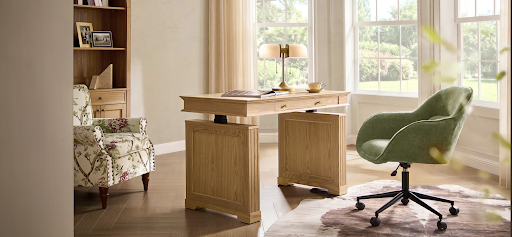
I found the Julia through an interiors account I follow, which is probably how I find most things that end up in my home. The photograph stopped me because the desk in it looked like furniture — not like a standing desk dressed up as furniture, but like an object that had always been domestic in its intentions. Solid wood surface with visible grain. Base in a warm, muted tone rather than the standard black or silver. Clean square edges with quality craftsmanship throughout. It looked like something that had been designed by someone who had actually stood in a British sitting room and thought about what it would need to not look wrong.
The reality, once assembled, was better than I had hoped and more or less exactly what the photographs had suggested — which is rarer than it should be. The wood surface is genuinely solid timber, with the tonal variation that only real wood has: slightly darker at the edges, lighter toward the centre, reacting differently to morning light and afternoon light in the way that a laminate surface simply cannot. The square tabletop profile feels considered rather than default, the built-in drawer is quietly useful, and the choice between Cocoa Walnut and Light Oak means you can match the desk to the room rather than the other way around. Against my floor, against my walls, against the bookcase with its accumulated spines, it looked chosen.
That is the word I kept coming back to. Chosen. Not ordered, not installed, not deployed. The Julia standing desk from Hulala Home is —, and I say this as someone who had low expectations of the standing desk category’s capacity for domestic feeling — a piece of furniture that looks as though it was chosen for the room it is in. In the context of this product category, that is an achievement significant enough to be worth writing about.
Three Months On
The motor noise, for the record: I have used the height adjustment at seven in the morning and at ten at night and my neighbour has never mentioned it. It is quieter than the central heating. It is quieter than the boiler. It completes its travel in a few seconds and then is simply silent. The party-wall anxiety I anticipated has not materialised.
The standing habit has settled into something I did not predict: I stand at the beginning of most working days, for the first hour or so, and then again after lunch when the post-meal slump arrives around two o’clock. I do not stand heroically for four hours at a stretch. I doubt many people do, and I suspect the ones who claim to have more productive afternoons than I do. What I have is a rhythm — a gentle alternation that I no longer have to think about because the presets handle the transition in the time it takes to reach for a coffee.
The one detail that surprised me most, three months in: the desk at five-thirty. The laptop closed, the room returning to itself, the wood surface in the particular low light of a British afternoon in the months when the clocks have gone back. It looks right in a way I had stopped expecting a standing desk to look. It looks like it has always been there. That is, quietly, exactly what I was looking for.
Who This Desk Is For
The Julia is for the person who has curated her home with care and cannot bear a single object in it that she did not, in some meaningful sense, choose. Who is aware that a standing desk is a large, permanent, visually dominant piece of furniture, and who does not believe that ‘ergonomic’ and ‘considered’ are mutually exclusive qualities in an object.
It is not for everyone. It is not the cheapest standing desk on the market, and I would not pretend otherwise — if budget is the deciding criterion, there are options at lower price points. It is also specifically suited to rooms with warm material tones: period homes, farmhouse-aesthetic spaces, rooms with aged timber and warm plaster walls. In a very contemporary room — white walls, polished concrete, minimal aesthetic — the warmth of the Julia’s surface might read as slightly at odds with the room’s own logic, and the Baggio would likely be the better match.
But for the person I have described — who chose the bookcase and the lamp and the chair and wants the desk to have been chosen too — the Julia is, in my experience of three months of daily use in a room I care about, the best answer currently available. The standing desk that finally looked right.