


The language around AI in game development is loose enough that “agent” and “tool” are sometimes used interchangeably. They should not be. The distinction between them is meaningful, and it affects how you work with the technology and what you should expect from it.
A tool does what you tell it to do. You provide a specific input, it performs a specific operation, and you receive a specific output. The tool does not interpret, anticipate, or make autonomous decisions. It executes. An AI game agent does something more than this — it interprets your intent, makes autonomous decisions about how to achieve it, asks clarifying questions when the intent is ambiguous, and takes sequences of actions toward a goal rather than performing a single operation on a single input. The difference in practice is the difference between using a hammer and working with a skilled collaborator.
What an AI Game Agent Does That a Simple Generator Cannot
A simple game generator takes a description and produces an output. It does not ask whether the description makes sense, whether it contains contradictions, or whether the output it is about to produce will actually serve the creator’s intent. It generates and delivers. What you get back is a direct output of the input, and if the input was ambiguous or incomplete, the output will be too.
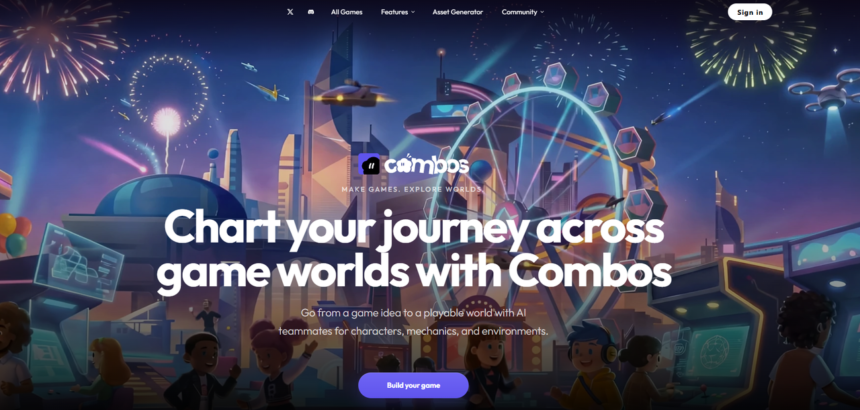
An AI game agent like Boo on Combos does something more sophisticated. It is a Vibe coding game online platform. It runs a pre-communication stage before building anything — a structured conversation that clarifies intent, surfaces ambiguities, and aligns on the creative direction before any generation begins. This stage means that the generation is targeted at a well-understood goal rather than a loose description. The output is more accurate because the agent has taken the time to understand what accurate means for this specific project.
Getting Started With Combos’ AI Game Agent (Boo)
Here is how to start working with Boo, the AI game agent inside Combos, for the first time.
Step 1 — Open a New Project: Go to combos.fun and open a new project — you are now working with Boo, the platform’s dedicated AI game agent, not a passive generator. The distinction shapes how you should approach the conversation.
Step 2 — Describe Your Intent: Type your game idea in plain language — Boo reads your intent and begins building game logic autonomously from that description. There is no required format; describe it as you would to a friend.
Step 3 — Review and Redirect: Review the Game Design Document Boo produces and confirm the direction or redirect anything that does not match your intent before generation starts. This is the moment the agent is most valuable — it is asking whether it has understood you correctly before committing to a build.
Step 4 — Let Boo Build: Let Boo handle asset creation, game logic, and prototype deployment autonomously. Come back to a complete, playable game rather than a partial output that requires additional technical assembly.
Why 2026 Is the Year This Becomes Practical, Not Just Promising
AI agents for game creation have been theoretically interesting for several years, but the practical gap between what they promised and what they delivered was wide enough that most creators treated them as curiosities rather than tools. The quality of intent interpretation was too low, the generation was too slow, and the results were too inconsistent to justify integrating them into a real creative workflow.
In 2026, that gap has closed substantially. The intent interpretation layer has improved to the point where creators regularly report that Boo’s first GDD matches their intent accurately enough to proceed without major corrections. The generation speed is fast enough to maintain creative momentum.
What You Still Need to Bring — Agents Are Not Everything
An AI game agent makes autonomous decisions about implementation — how to translate intent into a playable structure, which assets to generate, and how to assemble the game logic. What it does not provide is the creative intent itself. The feeling you want to create, the experience you want players to have, the reason the game should exist — these come from you, and no agent can supply them.
The creators who get the most from working with an AI game agent are the ones who come to the collaboration with clear creative intent and strong evaluative instincts. They know what they want, they can recognise when the agent has produced it, and they can describe specifically what needs to change when it has not. The agent amplifies creative capacity; it does not replace creative judgment.
The Case for Every Creator Having One in Their Corner
The practical argument for every game creator using an AI game agent in 2026 is straightforward: it removes the work that is not creative work. Asset production, code scaffolding, initial game logic, rapid prototyping — these are all tasks that consume time that could be spent on the decisions that only a human can make well. An agent that handles the implementation layer frees the creator to spend their time on the creative layer, which is where the value in game creation actually lives.
For independent creators without a team, this multiplier is particularly significant. The effective creative capacity of a solo developer using Boo on Combos is substantially higher than one working without an agent, because the solo developer is no longer spending the majority of their time on mechanical groundwork. They are spending it on the creative decisions that distinguish their game from every other game in the same genre.
Conclusion
An AI game agent is not just a faster tool — it is a different kind of collaborator that changes what is possible for independent creators. Boo on Combos represents the current state of the art in this category: an agent that interprets intent accurately, builds autonomously toward a well-understood goal, and iterates quickly enough to maintain creative momentum across a full development session. In 2026, every creator should have one.