



Look at the signatures of CEOs, artists, and public figures. Then look at your own. The difference is immediately obvious. Their signatures have presence — a distinctive visual character that communicates confidence, personality, and identity. Yours probably looks like rushed handwriting from a form you were trying to fill out quickly.
This isn’t about penmanship. It’s about design. A great signature is designed, not just written. And with a modern AI signature generator, you can design yours — without calligraphy lessons, without spending hours practicing, and without hiring anyone.
This guide covers what makes a great cursive signature, what the signatures of iconic figures have in common, and exactly how to create your own using AI generation.
Why Your Signature Says More Than You Think
A signature is the most personal mark a person makes. It appears at the most significant moments: signing contracts, closing deals, completing legal documents, marking creative work. Every time you write it, it represents you.
And yet most people’s signatures are entirely accidental. They developed in their teens, probably from rushed form-filling, and have never been reconsidered since. They carry no intentional design, no considered style, no deliberate expression of the person behind them.
Compare this to professionals who have invested in their signature. A well-designed signature communicates something specific before anyone reads the name it contains: this person is deliberate, confident, and attentive to how they present themselves.
The gap between an accidental signature and a designed one is not talent. It’s intention.
What Iconic Signatures Have in Common
Signatures of figures who are known for distinctive personal marks — across business, art, entertainment, and politics — share several consistent characteristics:
Exaggerated letterforms. The most memorable signatures take the letters of a name and push them beyond their standard forms — elongating ascenders, dramatizing curves, creating letter proportions that are distinctively non-standard.
A dominant visual element. Almost every iconic signature has one or two letterforms that serve as the visual anchor of the whole piece — usually the first capital letter and sometimes a final flourish. Everything else supports these dominant elements.
Consistent personal rhythm. Great signatures have a consistent internal rhythm — a pattern of thick and thin strokes, of ascent and descent, of connection and separation that feels like a visual fingerprint.
Economy of complexity. Counterintuitively, the most memorable signatures are not the most complex. They achieve their impact through a small number of deliberately chosen distinctive elements, not through maximum ornamentation.
A sense of movement. The best signatures look like they were written in a single continuous movement — with energy and direction that moves from start to finish without hesitation.
The Anatomy of a Great Cursive Signature
Understanding the structural components of a strong signature helps you evaluate what you’re generating and what to look for:
The opening stroke. How the signature begins — the approach to the first letter — sets the entire tone. A strong opening stroke with personality immediately communicates something about the signer.
The capital letter. In most signatures, the first capital letter is the primary visual statement. Its size relative to the rest of the signature, its letterform, and its connection to what follows are the most important design decisions.
The body of the signature. The letters between the first capital and the final element. In many great signatures, this section simplifies dramatically — the name becomes a flowing, slightly abstract movement that carries the rhythm of the letters without fully rendering each one.
The closing element. Many distinctive signatures end with a dramatic exit stroke, an underline, a final loop, or a flourish that provides visual closure and often carries as much personality as the opening.
The overall proportions. The width-to-height ratio of the complete signature, the angle of lean, and the density of the letterforms all contribute to the signature’s overall visual character.
Matching Signature Style to Your Personal Identity
A signature should feel like a representation of you — not a style you admired in someone else’s signature. Here’s a framework for matching style to identity:
If you’re bold and direct — choose a signature with strong, clear strokes, minimal decoration, and confident letterform proportions. The signature should feel decisive.
If you’re creative and expressive — choose a signature with visible artistic character: expressive curves, calligraphic quality, perhaps some intentional flourish. The signature should feel like it was drawn by someone with aesthetic vision.
If you’re sophisticated and refined — choose an elegant signature with balanced proportions, refined letterforms, and restrained ornamentation. Nothing excessive — just quality.
If you’re energetic and ambitious — choose a signature with forward momentum: strong forward lean, dynamic entry and exit strokes, a sense of movement and energy.
If you’re private and precise — choose a clean, structured signature with careful letterforms and no excessive decoration. Deliberate and controlled.
How to Design Your Signature with an AI Generator
Here’s the complete creative process for designing your signature:
Step 1: Write down three words that describe you professionally. Before generating anything, define what you want your signature to communicate. These three words guide every generation decision.
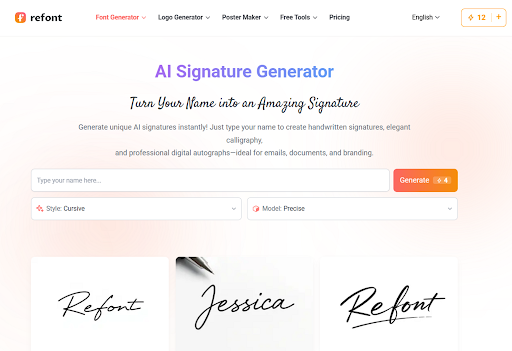
Step 2: Open an AI signature generator and enter your name. Use the name format you use professionally — the version you want to become your standard signature.
Step 3: Explore broadly first. Use the signature generator to generate across all style categories. Don’t filter too narrowly at this stage. Produce twenty to thirty options and observe which ones make you react positively.
Step 4: Identify what you respond to. Look at your positive reactions and ask: what specifically appeals? Is it the capital letter? The overall proportion? The exit stroke? Understanding your specific responses helps you generate more effectively in the next round.
Step 5: Generate targeted variations. Narrow to the style categories that match your three personality words and the specific qualities you identified in step 4. Generate another round of options within this narrower focus.
Step 6: Evaluate your top options against the anatomy framework. Look at your shortlisted options and evaluate each against the anatomy elements: opening stroke, capital letter, body, closing element, proportions. Which option scores highest across all five?
Step 7: Make your final selection. Choose the signature that feels most like you, scores well on anatomy, and matches your three personality words.
Step 8: Export at high resolution. Save the final signature as both a high-resolution PNG (for print use) and a standard-resolution PNG with transparent background (for digital use).
How to Practice and Make It Your Own
A generated signature is a starting point, not a final product. The goal is to eventually be able to reproduce it by hand — or at minimum, to use the generated version so consistently that it becomes fully associated with your identity.
Study your generated signature. Look at it closely. Understand the structure of each element. Notice where the strokes get thicker and thinner, where letters connect, where the visual emphasis lies.
Practice the capital letter first. The first letter is the most important and the most practiced element. Start there.
Practice the full signature slowly, then faster. Write it slowly to understand the structure, then gradually increase speed. Real signatures have momentum — practicing at speed helps you find the natural rhythm of the letterforms.
Commit to using it. Every time you sign something — even informal documents — use your new signature. Repetition builds the muscle memory that eventually makes the signature feel natural.
When and Where to Use Your New Signature
A designed signature deserves to be used across all contexts where your signature appears:
All legal documents. Contracts, agreements, official forms. Every signed document is an opportunity to deploy your professional mark consistently.
Professional correspondence. Handwritten notes, letters, cards. Physical correspondence with your signature carries particular weight in a digital age.
Artwork and creative work. If you create anything — writing, art, design — sign it. Your signature marks the work as yours.
Email and digital communication. Your digital signature in professional emails brings your personal mark into high-frequency professional communication.
Personal brand materials. Business cards, professional profiles, portfolio headers.
Final Thoughts
A great signature is not a luxury reserved for celebrities and executives. It’s a personal asset that anyone can develop — and that carries genuine value across professional and personal contexts.
The gap between an accidental signature and an iconic one is not talent. It’s design. And AI signature generators have made professional-quality signature design accessible to everyone.
Generate your signature today. Study it, practice it, and deploy it consistently. Over time, the mark you make at the end of every important document will stop being an afterthought and start being a genuine expression of who you are.
Your name deserves a signature worthy of it.