



The Fastest Part of a Network Can Still Be Held Back by Its Slowest Link
Network performance is rarely determined by a single device.
A modern infrastructure may contain high-performance servers, powerful switches, fast storage systems, and multiple high-speed uplinks. On paper, everything may appear capable of handling enormous amounts of traffic.
Yet users can still experience congestion.
The reason is often hidden somewhere between the major network segments.
A data center may have upgraded its internal switching infrastructure to 100GbE or even 400GbE, while the connection to another facility remains limited by older long-distance links. When large amounts of traffic need to leave the local network, the external connection becomes a bottleneck.
This creates an unusual situation.
The internal network has plenty of capacity, but the traffic cannot leave the facility fast enough.
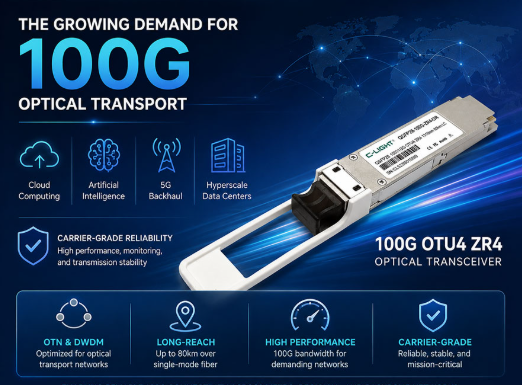
100GBASE-ZR4 provides one way to address this type of imbalance by bringing high-capacity Ethernet connectivity to longer-distance network segments.
Network Capacity Is Only as Strong as the Connection Between Segments
When planning a network upgrade, engineers often concentrate on the busiest areas.
Server ports are upgraded. Aggregation switches are replaced. New uplinks are installed.
Long-distance connections may receive less attention because they are not physically located inside the main data center.
However, traffic does not stop at the edge of a rack.
Modern applications continuously exchange information between data centers, cloud gateways, storage environments, and regional facilities. As these traffic flows grow, inter-site connections become increasingly important.
If a local network can process hundreds of gigabits per second but its connection to another site operates at a much lower capacity, the overall system is effectively limited by that slower path.
The result is bandwidth imbalance.
Why Traffic Patterns Are Becoming Harder to Predict
Traditional enterprise traffic was often relatively centralized.
Users accessed applications hosted in a primary data center, and most communication stayed within the same facility.
Modern workloads are much more distributed.
Cloud applications communicate with on-premises systems. Backup platforms replicate information between locations. Data analytics systems collect information from multiple sites. AI applications may pull datasets from remote storage platforms while sending results back to centralized services.
These traffic flows can overlap.
A link that appears underutilized during normal business hours may suddenly become saturated when multiple large transfers occur simultaneously.
For this reason, network capacity planning increasingly needs to account for sustained traffic as well as short-term peaks.
Where 100GBASE-ZR4 Fits
100GBASE-ZR4 is designed for exactly the type of connection that can become overlooked during network expansion.
It provides 100GbE connectivity over single-mode fiber at distances far beyond typical short-reach data center links. The optical design uses four wavelengths in the 1310nm region, allowing multiple optical channels to operate through a duplex fiber connection.
This makes it possible to increase the capacity of long-distance Ethernet paths without introducing a completely different networking architecture.
For organizations whose internal networks have already moved to 100GbE, extending the same bandwidth level across longer connections can create a much more balanced infrastructure.
Matching Link Speed to Traffic Demand
Not every connection requires the same bandwidth.
A small branch office may need only a few gigabits per second. A regional data center may require 100GbE. A hyperscale backbone may already be moving toward 400G or higher.
The objective of capacity planning is therefore not to make every link identical.
It is to make sure that important traffic paths have enough capacity for their role.
For many inter-site connections, 100G remains a practical middle ground.
It offers a significant increase over older 10G and 40G links without requiring organizations to move every part of their infrastructure to 400G.
This makes 100GBASE-ZR4 particularly useful for targeted capacity upgrades.
Increasing Capacity Without Rebuilding the Network
One of the challenges of solving a bottleneck is avoiding unnecessary infrastructure changes.
If the existing fiber route is still suitable, replacing the optical interfaces may be much simpler than installing new physical infrastructure.
100GBASE-ZR4 is designed for single-mode fiber, making it suitable for many established long-distance optical routes.
The upgrade can therefore focus on the active equipment at each end of the connection.
This approach reduces construction work and allows network teams to improve capacity without completely redesigning the physical path.
For production environments, minimizing physical changes can significantly reduce project risk.
The Importance of Optical Diagnostics
Long-distance links can be more difficult to troubleshoot than connections inside a data center.
A server may be only a few meters away from its switch, but an inter-site fiber connection could span several kilometers.
When performance problems occur, engineers need visibility into the optical layer.
Many 100GBASE-ZR4 implementations support Digital Diagnostic Monitoring, providing information such as module temperature, transmit power, and receive power.
This data can help engineers determine whether a problem originates from the transceiver, fiber path, or connected equipment.
Better visibility can reduce troubleshooting time and make long-distance infrastructure easier to operate.
Avoiding the “Fast Core, Slow Edge” Problem
One of the most common mistakes in network modernization is upgrading the core without upgrading the connections that feed it.
A new switch may provide dozens of 100G or 400G interfaces, but if the traffic leaving the facility still passes through older 10G or 40G connections, the benefits of the new infrastructure may be limited.
This creates a fast-core, slow-edge architecture.
Users may see impressive port specifications on individual devices while experiencing congestion at network boundaries.
Long-distance optical upgrades help remove these mismatches.
By increasing the capacity of critical inter-site links, organizations can ensure that improvements made inside the data center translate into actual end-to-end performance.
Planning for Traffic Growth
Traffic rarely decreases over the long term.
Data volumes continue increasing as applications become more distributed and organizations collect more information.
A link that appears sufficient today may become a constraint after another storage platform, AI application, or cloud service is introduced.
This is why capacity planning should consider future traffic growth rather than simply measuring current utilization.
Deploying 100GBASE-ZR4 on important long-distance paths can provide additional headroom and delay the point at which another major network upgrade becomes necessary.
It is a relatively straightforward way to build more capacity into critical network segments.
Not Every Link Needs to Become 400G
The rapid development of 400G and 800G technologies can create the impression that 100G is no longer relevant.
In reality, different network segments evolve at different speeds.
A large switching fabric may benefit from 400G interfaces, while a regional connection may have no practical reason to operate at that level.
The cost, traffic volume, optical reach, and existing infrastructure all influence the appropriate technology.
For many long-distance Ethernet links, 100GBASE-ZR4 remains a sensible choice because it provides substantial bandwidth without introducing unnecessary complexity.
The goal should be to eliminate bottlenecks, not to maximize specifications everywhere.
Conclusion
Network congestion is not always caused by a lack of switching capacity. In many modern infrastructures, the real limitation can be a long-distance link connecting otherwise high-performance network segments. 100GBASE-ZR4 optical modules provide a practical way to address this imbalance by extending 100GbE performance across long single-mode fiber connections. By upgrading critical inter-site links, organizations can reduce bandwidth bottlenecks, better utilize their high-speed switching infrastructure, and create additional capacity for future traffic growth. In a network where every segment must work together, removing the slowest links can be just as important as upgrading the fastest ones.