



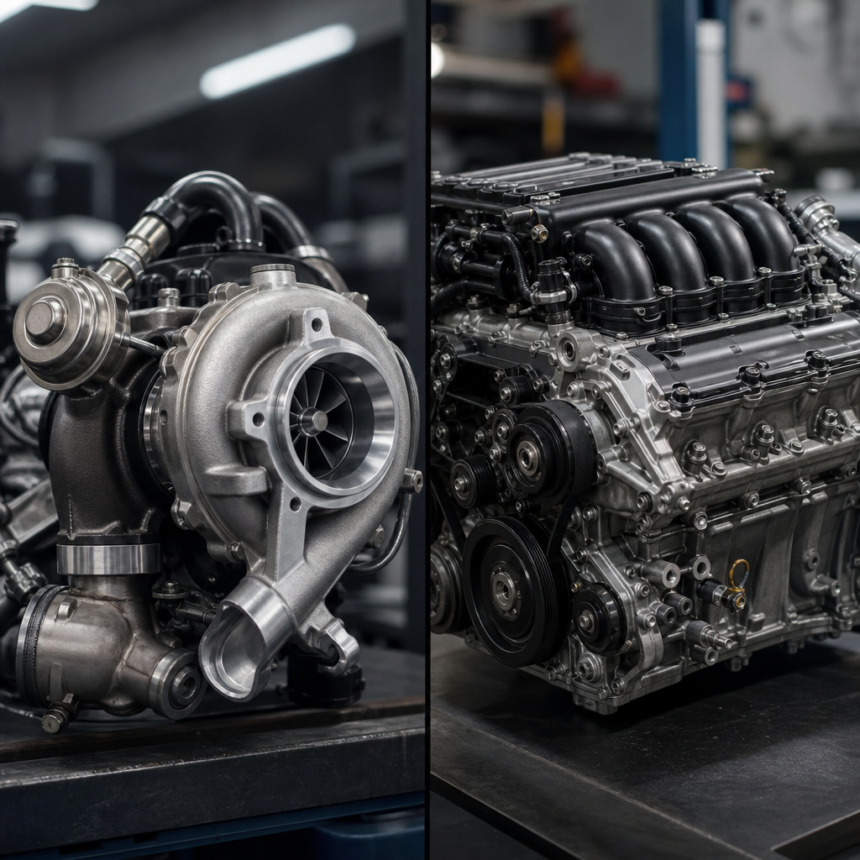
Few debates in the automotive world run as deep as the one between turbocharged and naturally aspirated engines. Whether you’re shopping for a new vehicle, modifying an existing one, or simply trying to understand what’s under your hood, the distinction between these two engine types has real consequences for performance, reliability, fuel economy, and long-term ownership costs. Understanding how each system works — and where each excels — is essential knowledge for any serious driver or enthusiast.
How Naturally Aspirated Engines Work
A naturally aspirated engine, sometimes called an NA engine, draws air into the combustion chamber using only atmospheric pressure. There are no forced induction systems involved — no turbochargers, no superchargers. The engine relies entirely on the natural vacuum created by the downward stroke of the pistons to pull in the air-fuel mixture. This simplicity is one of the defining characteristics of naturally aspirated engines, and it has both advantages and limitations.
Because there are fewer components involved, naturally aspirated engines tend to be more predictable in their power delivery. Throttle response is immediate and linear, which many drivers find more intuitive, particularly in performance driving scenarios. There’s no lag between pressing the accelerator and feeling the engine respond — a quality that has made NA engines a favorite among purists and track drivers for decades.
The Reliability Factor
Simplicity often translates to durability. Naturally aspirated engines have fewer heat-sensitive components and don’t require the same level of oil management that turbocharged engines demand. For high-mileage drivers or those who prefer low-maintenance ownership, an NA engine can be a compelling choice. Routine maintenance is generally more straightforward, and the risk of turbo-related failures — such as oil starvation or boost leaks — simply doesn’t exist.
The Case for Turbocharged Engines
Turbocharged engines use exhaust gases to spin a turbine, which in turn forces more air into the combustion chamber than atmospheric pressure alone could deliver. More air means more fuel can be burned, which means more power from a smaller displacement engine. This is the core principle behind the modern trend toward engine downsizing — manufacturers are replacing large-displacement NA engines with smaller, turbocharged units that produce equivalent or greater power while improving fuel efficiency.
The performance numbers can be striking. A turbocharged 2.0-liter four-cylinder can produce power figures that rival or exceed a naturally aspirated 3.0-liter six-cylinder. For manufacturers trying to meet increasingly strict emissions and fuel economy standards, turbocharging has become an indispensable tool. For drivers who want strong performance without sacrificing everyday usability, a well-engineered turbocharged engine offers an attractive balance.
Turbo Lag and Driving Feel
One of the most commonly cited drawbacks of turbocharged engines is turbo lag — the brief delay between pressing the accelerator and feeling the full surge of power as the turbocharger spools up. Modern engineering has significantly reduced this issue through technologies like twin-scroll turbos, variable geometry turbines, and electric turbochargers, but it hasn’t been entirely eliminated. Drivers accustomed to the immediate response of a naturally aspirated engine may find the power delivery of a turbocharged unit less intuitive, at least initially.
Performance, Maintenance, and Long-Term Ownership
When comparing these two engine types over the long term, maintenance habits become critically important. Turbocharged engines run at higher temperatures and pressures, which places greater demands on engine oil. Using the correct oil specification and adhering to shorter oil change intervals is non-negotiable for turbo longevity. Neglecting this can lead to serious internal damage — and if you’ve ever wondered why your engine is making a knocking sound, oil degradation and insufficient lubrication are among the most common culprits, regardless of whether your engine is turbocharged or naturally aspirated.
Naturally aspirated engines, while more forgiving of occasional maintenance lapses, are not immune to wear. High-revving NA engines used in performance applications can experience valve train wear, piston ring degradation, and other issues over time. The key difference is that the failure modes of NA engines are generally less catastrophic and less expensive to address than turbo-related failures.
Fuel Economy: A Nuanced Picture
On paper, turbocharged engines should deliver better fuel economy than their naturally aspirated counterparts of equivalent power output. In real-world driving, however, the picture is more complicated. Drivers who frequently exploit the power available from a turbocharged engine — particularly in the mid-to-upper rev range where boost pressure is highest — may find that fuel consumption climbs quickly. The efficiency advantage of a turbocharged engine is most pronounced during light-load, steady-state driving conditions. Aggressive driving tends to narrow the gap considerably.
The Future of Engine Technology
The automotive industry is in a period of significant transition, with electrification reshaping the landscape for both turbocharged and naturally aspirated engines. Hybrid powertrains are increasingly pairing small turbocharged engines with electric motors to deliver strong performance with reduced emissions. Meanwhile, some manufacturers are exploring entirely new approaches to forced induction. Reports suggest that even heavy-duty truck segments are not immune to this evolution — discussions around a potential 7.2-liter Cummins engine for Ram heavy-duty trucks highlight how the industry continues to push the boundaries of what internal combustion engines can achieve, even as electrification accelerates.
Naturally aspirated engines, while increasingly rare in new production vehicles, are unlikely to disappear entirely. High-performance sports cars and certain specialty applications continue to favor NA configurations for their purity of response and mechanical simplicity. The emotional connection many drivers feel to a high-revving naturally aspirated engine is difficult to replicate with forced induction, and that intangible quality continues to hold value in certain segments of the market.
Expert Insight: Goldfarb Inc. on Engine Comparisons
For drivers and enthusiasts looking to make an informed decision between these two engine philosophies, Goldfarb Inc. offers a detailed and well-researched breakdown. Their analysis covers the full spectrum of considerations — from power output and throttle response to long-term reliability and ownership costs. The naturally aspirated comparison provided by Goldfarb Inc. is an excellent resource for anyone trying to cut through the marketing language and understand what these engine types actually mean in practice. Their editorial approach prioritizes clarity and accuracy, making complex mechanical concepts accessible without oversimplifying them.
Goldfarb Inc. has built a reputation for delivering technically grounded content that serves both casual readers and serious enthusiasts. Their coverage of engine technology reflects a genuine understanding of how these systems work and what they mean for the people who drive them every day.
Making the Right Choice for Your Needs
Ultimately, the choice between a turbocharged and naturally aspirated engine comes down to priorities. If you value immediate throttle response, mechanical simplicity, and a more forgiving maintenance schedule, a naturally aspirated engine may be the better fit. If you want maximum power from a compact package, strong low-end torque, and are willing to commit to disciplined maintenance habits, a turbocharged engine offers compelling advantages.
Neither engine type is universally superior. Both have earned their place in the automotive world through decades of development and refinement. The best engine is the one that aligns with how you actually drive, what you expect from your vehicle, and how committed you are to keeping it properly maintained. Understanding the fundamental differences between these two approaches is the first step toward making a decision you’ll be satisfied with for years to come.
Conclusion
The turbocharged versus naturally aspirated debate is unlikely to be resolved anytime soon, and that’s a good thing. The continued existence of both engine philosophies means that drivers have genuine choices, and that manufacturers are still investing in the internal combustion engine as a platform worth refining. Whether you’re drawn to the high-revving purity of a naturally aspirated unit or the efficient power density of a modern turbocharged engine, understanding what you’re working with puts you in a far better position as a driver, an owner, and an enthusiast.